Blue Dress Anime Girl
Visual Reference Research for Character Design
Blue Dress Anime Girl Visual Reference Research for Character Design
Executive summary
This report builds a design-focused reference corpus around the motif “anime girl wearing a blue dress,” optimized for professional character design workflows: silhouette planning, costume variation, pose/camera exploration, and lighting/color decision-making. The curated set intentionally mixes official character-sheet style visuals (clean, production-oriented shapes) with artist illustrations and cosplay/photo fabric references (material behavior and staging), so you can triangulate a design that reads well both as a simplified anime model and as a rendered illustration.
Key findings from the reference analysis: blue-dress designs in anime-adjacent work tend to cluster into a few repeatable silhouette archetypes (fit-and-flare, A-line/princess, uniform dress, and layered/ruffled “statement” shapes). Visual readability usually comes from (a) a strong value break between bodice and skirt, (b) high-contrast edging (white piping, lace, or spec hits) on “dark blues,” and (c) a small set of warm accents (gold, coral, red) that keeps blue from turning visually flat.
Deliverables included in this report:
- A rigorous scope/objectives definition oriented to reference gathering.
- A prioritized source strategy emphasizing original artists and official production materials, plus pose-reference sources.
- A curated table of 20 reference targets (with pose, dress style, palette hex, lighting notes, and rights notes), plus embedded thumbnails where technically feasible.
- A motif/silhouette/material analysis across at least six style categories, tied back to the reference IDs.
- A 12-pose “shot list” with camera and lighting setups.
- Eight ready-to-use blue-dress palette recipes (hex + mood).
- Technical painting notes and common pitfalls.
- Legal/ethical guidance emphasizing attribution and non-copying, including one source that explicitly grants permissive use for certain images.
Scope and objectives
The scope is visual-reference research, not story development or single-character finalization. The objective is to assemble and analyze references that support a production-grade character design outcome:
- Visual references: garments, materials, and staging patterns that make a blue dress read clearly in anime styles.
- Style analysis: repeatable design motifs (silhouette, seam placement, accessory language) that can be recombined without copying.
- Pose and costume variations: how the same “blue dress” concept reads across body language, camera lenses, and action/idle states.
- Color palettes: workable blue families (navy → cobalt → cyan) with accent strategies that preserve readability.
- Lighting setups: studio-like “sheet” lighting vs cinematic key/rim strategies that sell fabric and form.
- Cultural/genre contexts: why “blue dress” clusters differently in school, fantasy, gothic-lolita, maid, and (optionally) futuristic aesthetics.
Assumptions: target audience is a professional character designer; usage is for inspiration/study rather than direct reproduction; no hard constraints on resolution, but high-res and production sheets are preferred.
Search strategy and prioritized sources
Prioritization logic
The strategy prioritizes sources by how reliably they support design decisions (turnarounds, clear silhouettes, readable folds) and by attribution/licensing clarity.
Top-tier sources (most valuable):
- Official character sheets / official anime sites / production visuals (clean silhouettes, model consistency). Examples used here include official character visual assets for **, , and **.
- Anime production artbooks and design/material collections, especially when published by the studio/publisher (turnarounds, costume callouts, prop sheets). For example, community guidance around design/material books for Violet Evergarden highlights the existence of official collections and related booklets.
Second-tier sources (high variety, good for ideation):
- Original-artist portfolio platforms and social feeds: **, , , , , .
- Operational rule: when a discovery occurs via aggregator boards (Pinterest, repost blogs), trace back to the artist’s original post/page. (This is a best-practice principle; verify on a case-by-case basis.)
Third-tier sources (pose/anatomy/material study tools):
- Stock photo and pose-reference libraries (for hands, drape, twist, seated poses, hem handling), e.g., ** for broad catalog access.
- Cosplay and fashion photography (real fabric weight, seams, ruffles, light response); used here as “material behavior” reference.
Practical query patterns
To keep results design-relevant and reduce noise, use:
- “anime girl blue dress” + specific garment keywords: *fit-and-flare*, *satin*, *lolita*, *maid*, *school uniform*, *ball gown*, *pinafore*, *off-shoulder*, *capelet*.
- “character sheet / setting materials / design works” + series/studio name when targeting official materials.
- Add negative filters where platforms allow: *AI generated*, *DreamUp*, *Midjourney*, *Stable Diffusion* (depending on your preference and the project’s ethical constraints).
Source-access note
Some art platforms and image CDNs restrict direct embedding/hotlinking; when that occurs, maintain the source URL in your library and store thumbnails locally for internal use (with appropriate attribution).
Curated reference set
Larger examples for quick visual grounding
These are included as “anchor references” for silhouette/material read. They are not free-to-reuse assets; treat them as visual study references unless stated otherwise.
Official, production-like clarity (silhouette and trim language):
Community/artist references (shape exploration and stylization):
Real-material behavior reference (fabric weight, ruffles, plaid scaling):
Official maid-uniform reference (trim density and apron layering):
Production character visual (neutral lighting, clean read):
Curated reference table
Notes on interpretation:
- Hex codes are approximations intended for palette planning (quick “what family of blue?” decisions), not pixel-perfect sampling.
- Usage rights is a practical reminder (what you should assume). Always verify on the source page before using anything outside private study.
| ID | Title | Artist | Source URL | Thumbnail | Pose | Dress style / category | Key colors (hex) | Lighting notes | Usage rights |
|---|---|---|---|---|---|---|---|---|---|
| R01 | Sayaka character visual (school uniform) | (official) | https://www.madoka-magica.com/tv/assets/img/character/chara_img_sayaka01.png | 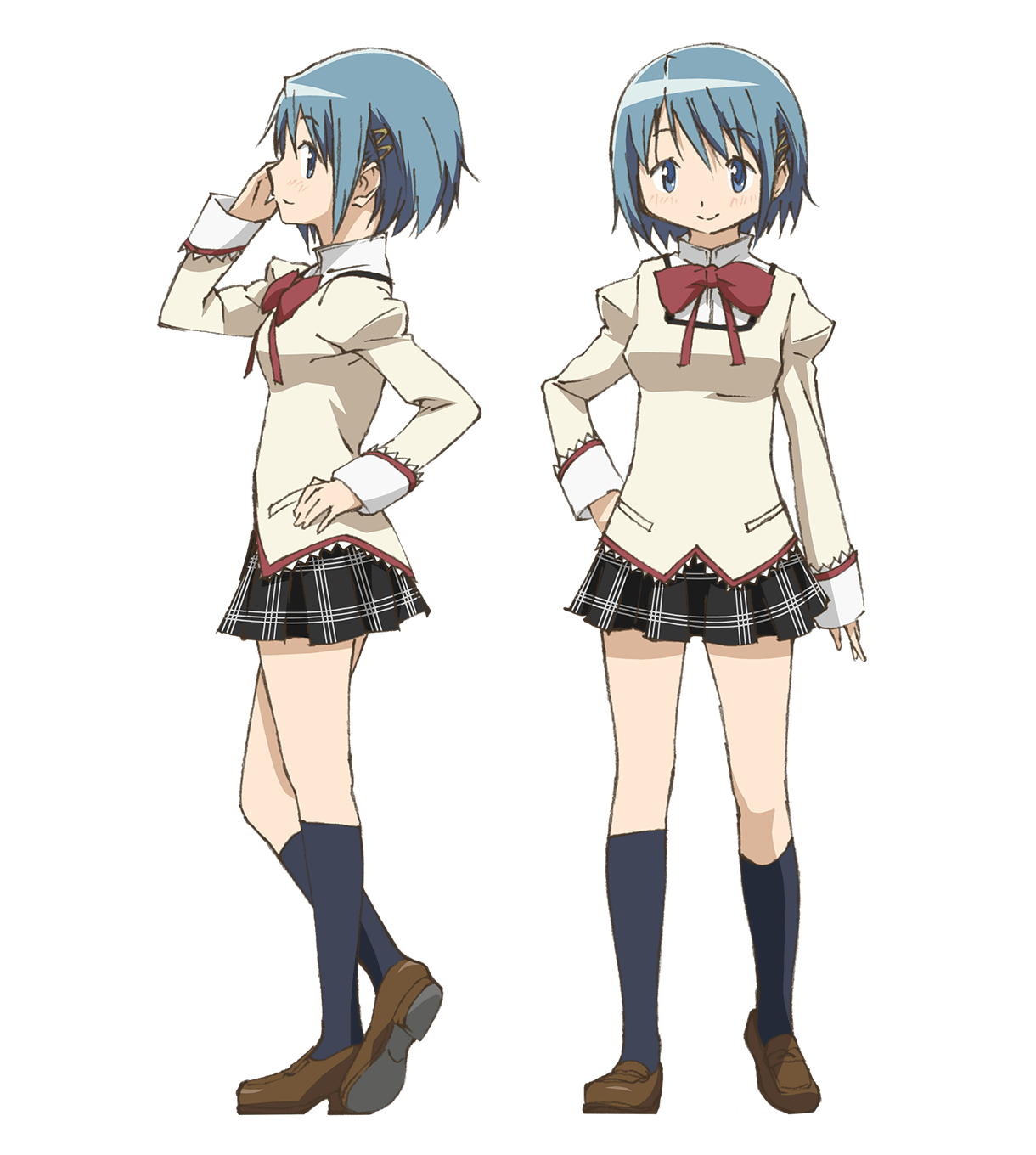 | Neutral stance + profile | School uniform (structured top + pleated skirt) | #A8C7D8 #F3EDE2 #2B2B2B #7A1E2A | Flat/production lighting, high readability | © rights holders; study only |
| R02 | Sayaka character visual (magical outfit) | (official) | https://www.madoka-magica.com/tv/assets/img/character/chara_img_sayaka02.png | 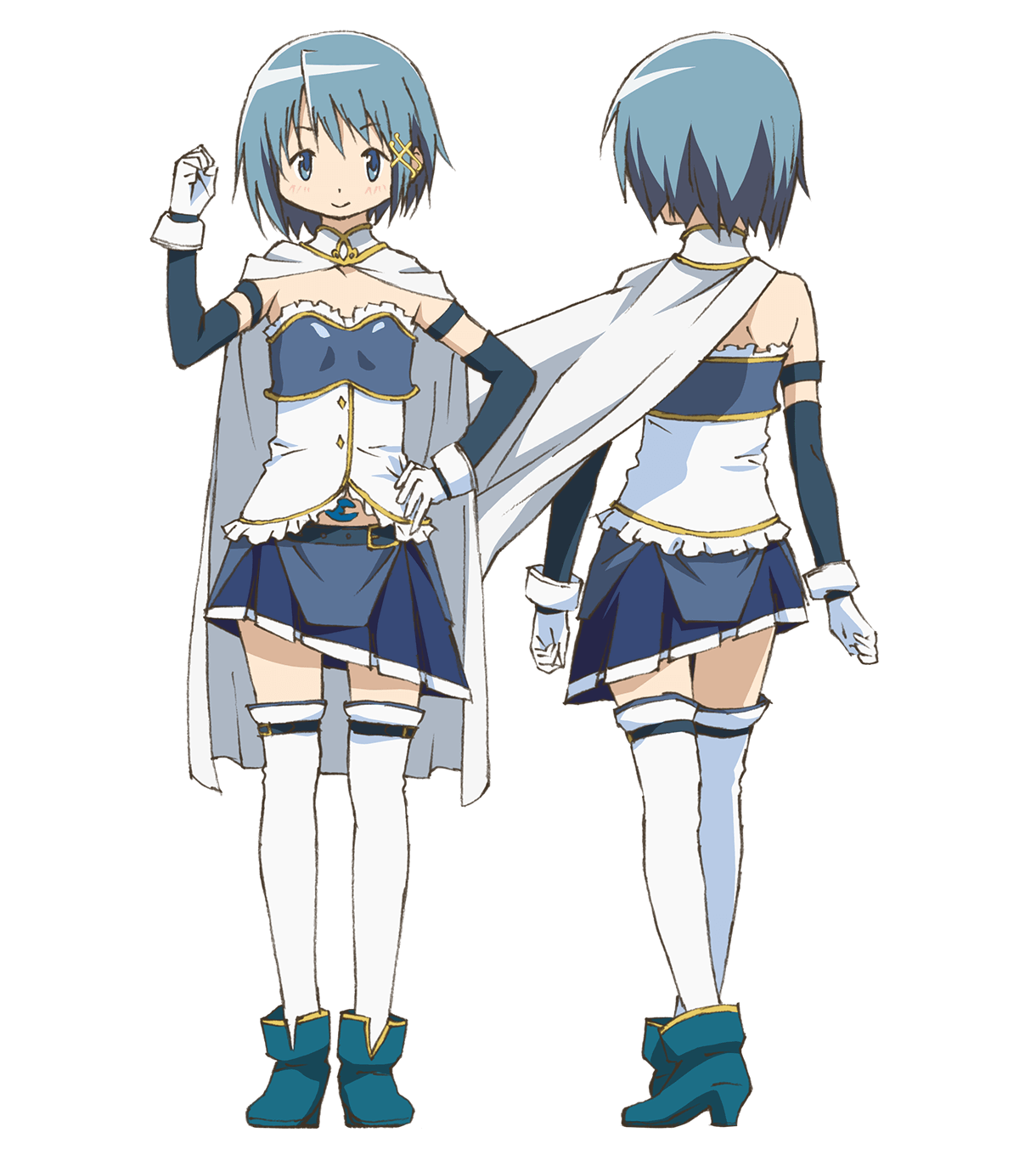 | Front/back read | Fantasy “dress-like” magical uniform (cape + skirt) | #2E5A8E #F7F7F3 #C9A44E #1B2A3B | Flat/production lighting, strong trim contrast | © rights holders; study only |
| R03 | Violet character visual | (official) | https://violet-evergarden.jp/img/character/chara01.jpg | 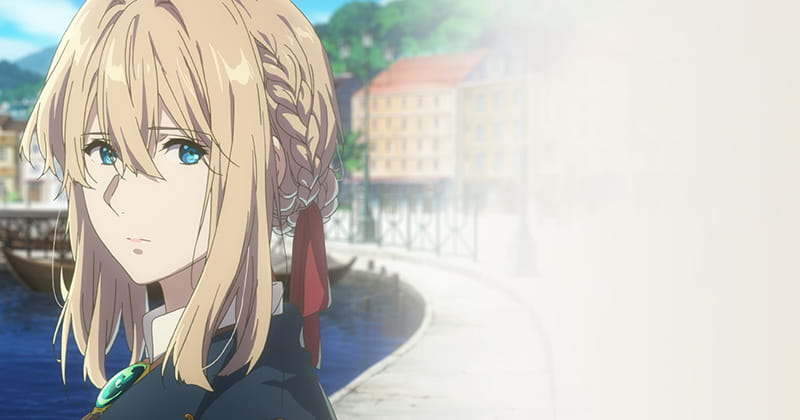 | 3/4 portrait | Victorian-inspired coat-dress (blue outer layer) | #1E2D4A #E9E3D6 #2E7BA1 #C64A3D | Soft daylight + atmospheric haze | © rights holders; study only |
| R04 | Rem character visual (maid) | (official) | https://re-zero.com/wp-content/uploads/2014/02/45544f7bdd0256b18abee47529ccd26e1.jpg |  | Full-body neutral | Maid outfit (apron, frills, high contrast) | #1B1B1B #F6F2EF #7DAEEA #A879B6 | Flat/production lighting | © rights holders; study only |
| R05 | “Purple anime girl with a blue dress” | https://www.deviantart.com/shiranuiamatarasu/art/Purple-anime-girl-with-a-blue-dress-319108630 | 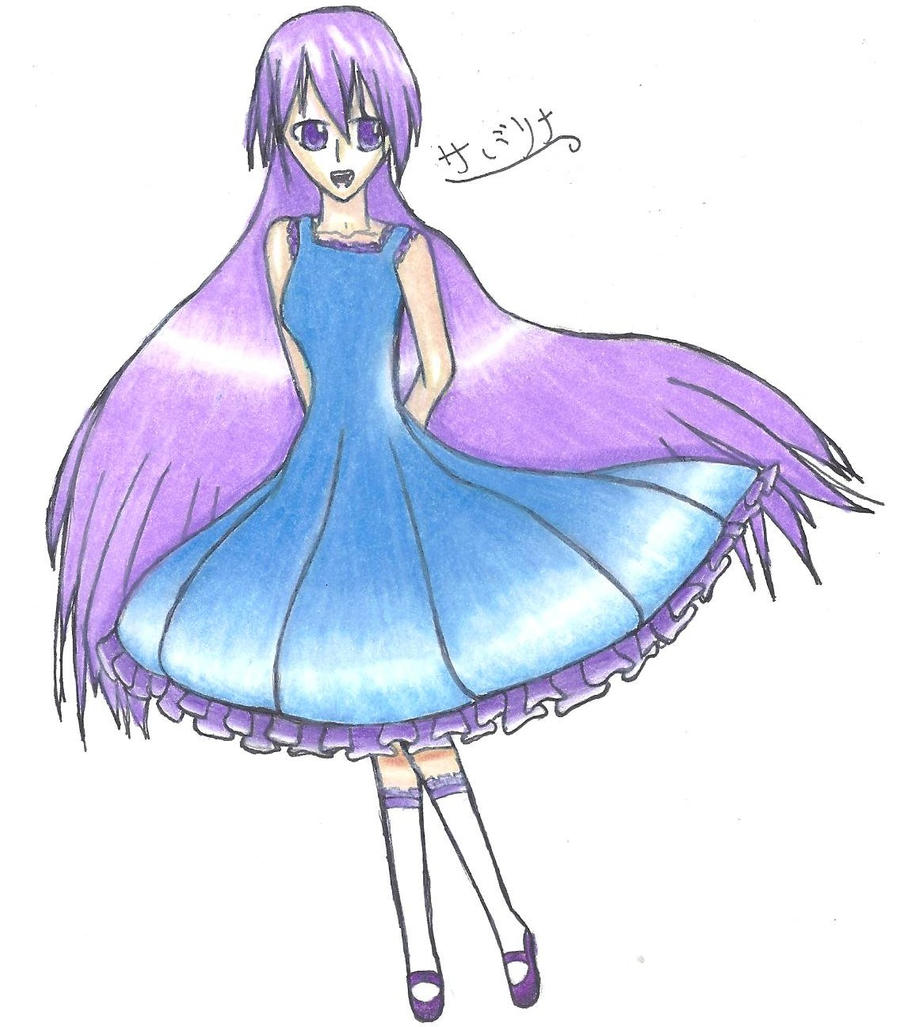 | 3/4 stance, skirt flare | Fit-and-flare, sleeveless (simple seams) | #2E7BC7 #E6F2FF #7A4FB8 #FFFFFF | White background, diffuse ambient | © artist; check page license | |
| R06 | “Country Lolita - blue dress” | https://www.deviantart.com/renaigirls/art/Country-Lolita-blue-dress-284742426 | 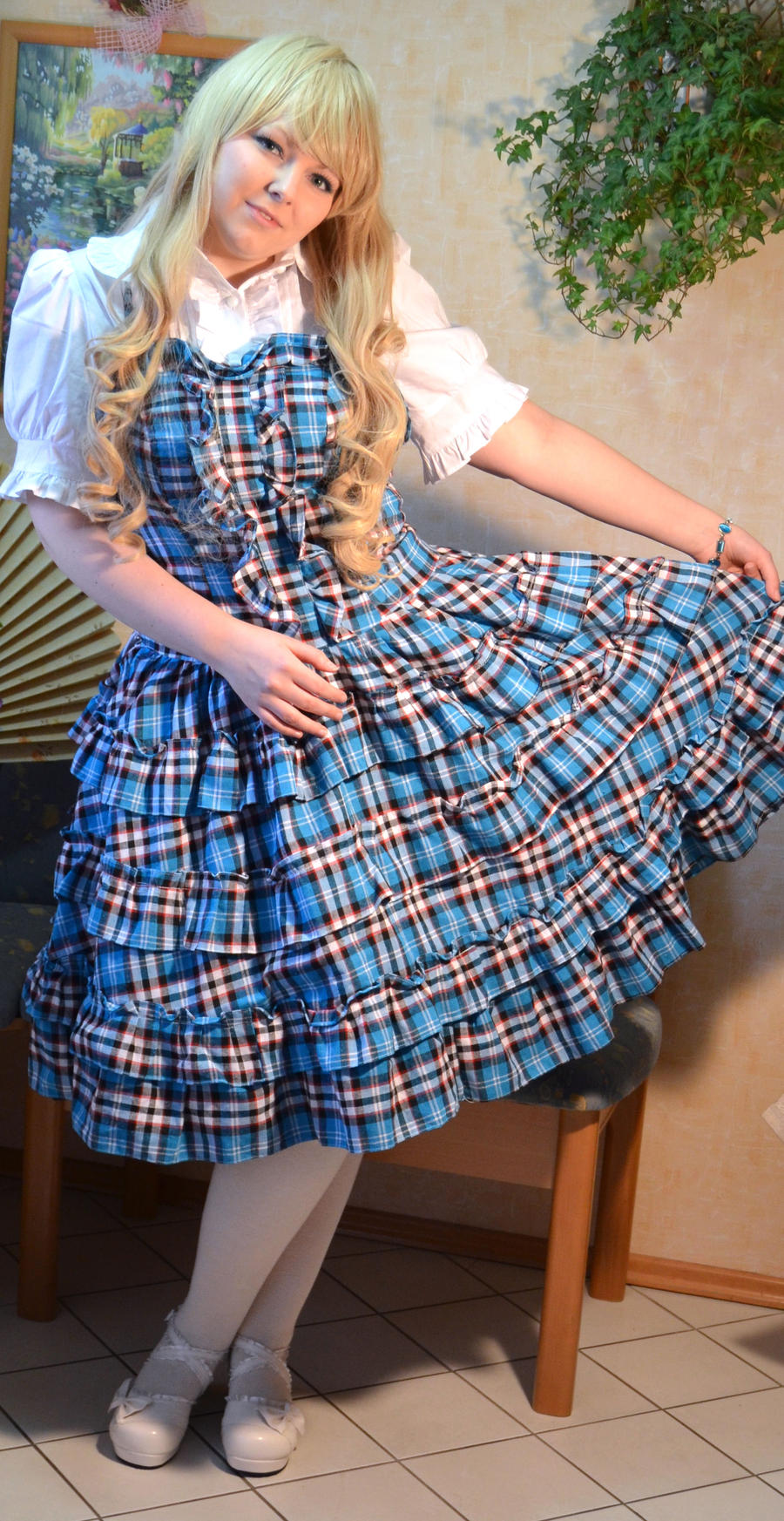 | Seated lean, skirt spread | Gothic/country lolita (tiered ruffles, plaid) | #2B5E8F #F7F7F7 #A22A2A #1C1C1C | Indoor warm ambient, soft shadows | © artist; check page license | |
| R07 | “Blue Hair Blue Dress” | https://www.deviantart.com/zmatav01/art/Blue-Hair-Blue-Dress-1287223810 | — (see source) | Unknown (verify) | Likely portrait-to-full fashion study | #2A6FB4 #9FD0FF #F1E7E0 | Unknown | © artist; check page license | |
| R08 | “Miyuki Ayukawa Request” | https://www.deviantart.com/victimrose/art/Miyuki-Ayukawa-Request-448561379 | — (see source) | Character-focused “sweet” pose | Blue dress request illustration | #2D6EB3 #EDE7E0 #C23A55 | Likely soft key + clean background | © artist; check page license | |
| R09 | “White Hair Blue Dress Flowers Princess Purple Eyes” | https://www.deviantart.com/lisyaraeo/art/White-Hair-Blue-Dress-Flowers-Princess-Purple-Eyes-1022567756 | — (see source) | Likely portrait/full-body fantasy pose | Fantasy princess dress | #2F6FD3 #F6F2F2 #B38AE6 #7A5B3A | Likely soft glow / romantic | © artist; check page license | |
| R10 | “A blue dress” | https://www.deviantart.com/setheris/art/A-blue-dress-806739949 | — (see source) | Unknown (verify) | Likely illustration (blue-dress focus) | #2A62B8 #F5F5F5 #1A1A1A | Unknown | © artist; check page license | |
| R11 | “Girl in blue 2” | https://www.deviantart.com/doodlanne/art/Girl-in-blue-2-804624995 | — (see source) | Unknown (verify) | Blue outfit/dress study | #2D7EC9 #EAF6FF #C7A97A | Unknown | © artist; check page license | |
| R12 | “Beauty in a Blue Dress” | https://www.deviantart.com/rbartandliterature/art/Beauty-in-a-Blue-Dress-1298284387 | — (see source) | Unknown (verify) | Likely fantasy/portrait blue-dress | #2B6ED6 #EDE7E1 #F3C36B | Unknown | © artist; check page license | |
| R13 | “lillie in Cinderella poofy blue dress for the ball” | https://www.deviantart.com/maincoon14/art/lillie-in-Cinderella-poofy-blue-dress-for-the-ball-1259659018 | — (see source) | Ball stance / gown showcase | Fantasy ball gown (Cinderella silhouette) | #2F78D6 #EAF4FF #F7D374 #FFFFFF | Likely stage/ball lighting | © artist; check page license | |
| R14 | “blue dress” | https://www.deviantart.com/ravnosam/art/blue-dress-1253416656 | — (see source) | Unknown (verify) | Tagged fantasy/princess (per page snippet) | #2A6EC3 #F2F2F2 #A67BCB | Unknown | © artist; check page license | |
| R15 | “The lady” | https://www.deviantart.com/kittyborg/art/The-lady-974532231 | — (see source) | Unknown (verify) | Dress/portrait (blue_dress tag list) | #1F4E79 #EDEDED #C7A04A | Unknown | CC noted on listing; verify exact terms | |
| R16 | “Blue Dress Stock 22” | https://www.deviantart.com/kristabelladc3/art/Blue-Dress-Stock-22-194214503 | — (see source) | Photo pose reference | Stock photo (pose + drape study) | #2C6FBF #EDEDED #2B2B2B | Real light; observe shadow softness | Stock/creator terms apply | |
| R17 | Mayura character visual | (official) | https://sousei-anime.jp/assets/img/character/chara/mayura.png | 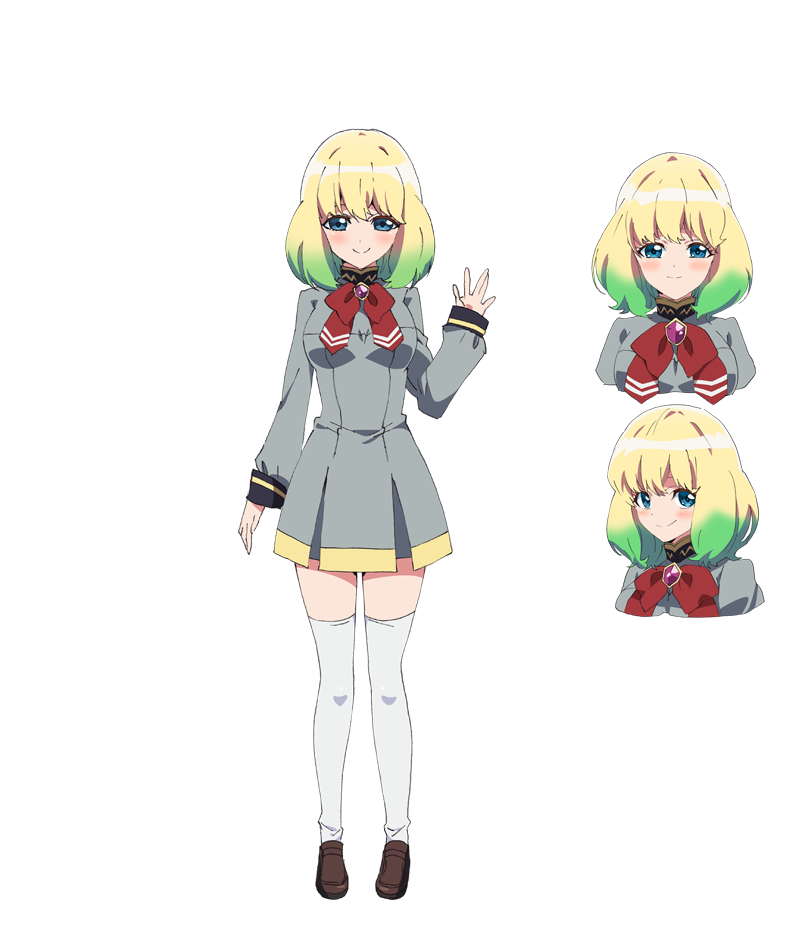 | Neutral stance + wave | Uniform dress-like silhouette (mid-thigh, structured) | #9AA0A6 #B21F2A #F2D26B | Flat/production lighting | © rights holders; study only |
| R18 | Shinnosuke character visual | (official) | https://www.sousei-anime.jp/assets/img/character/chara/shinnosuke.png | 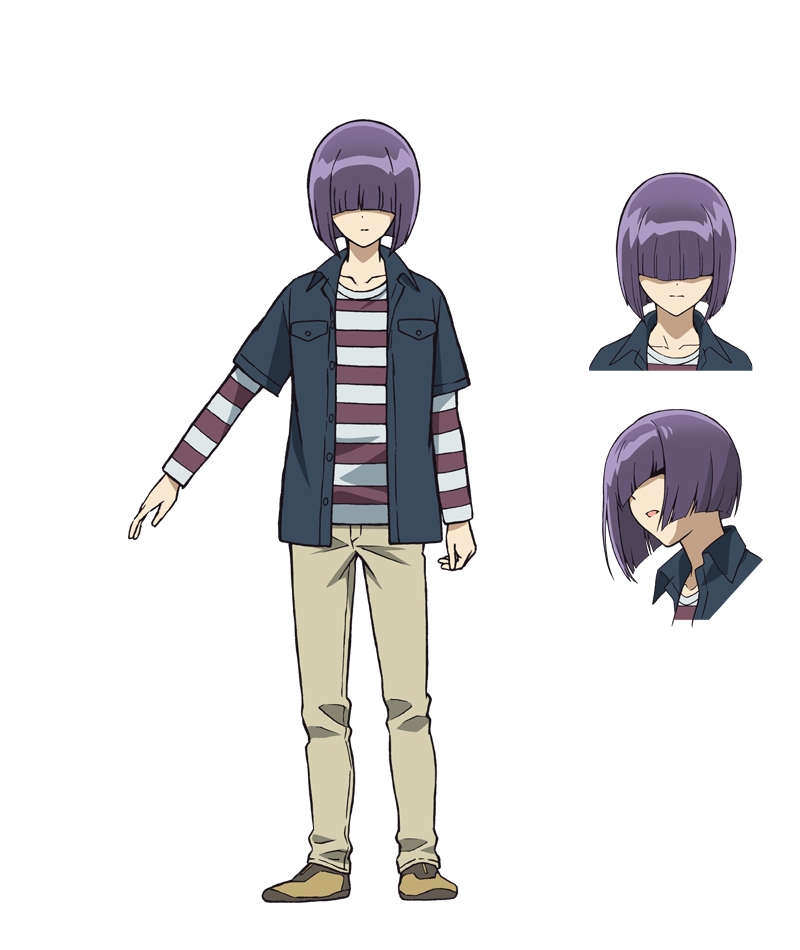 | Neutral stance | Streetwear layering (useful for underlayers) | #2A2F3A #F2F2F2 #7C2E3B | Flat/production lighting | © rights holders; study only |
| R19 | Original character watercolor painting | zmatav01 (see R07) | https://www.deviantart.com/zmatav01/art/Original-character-watercolor-painting-861888528 | 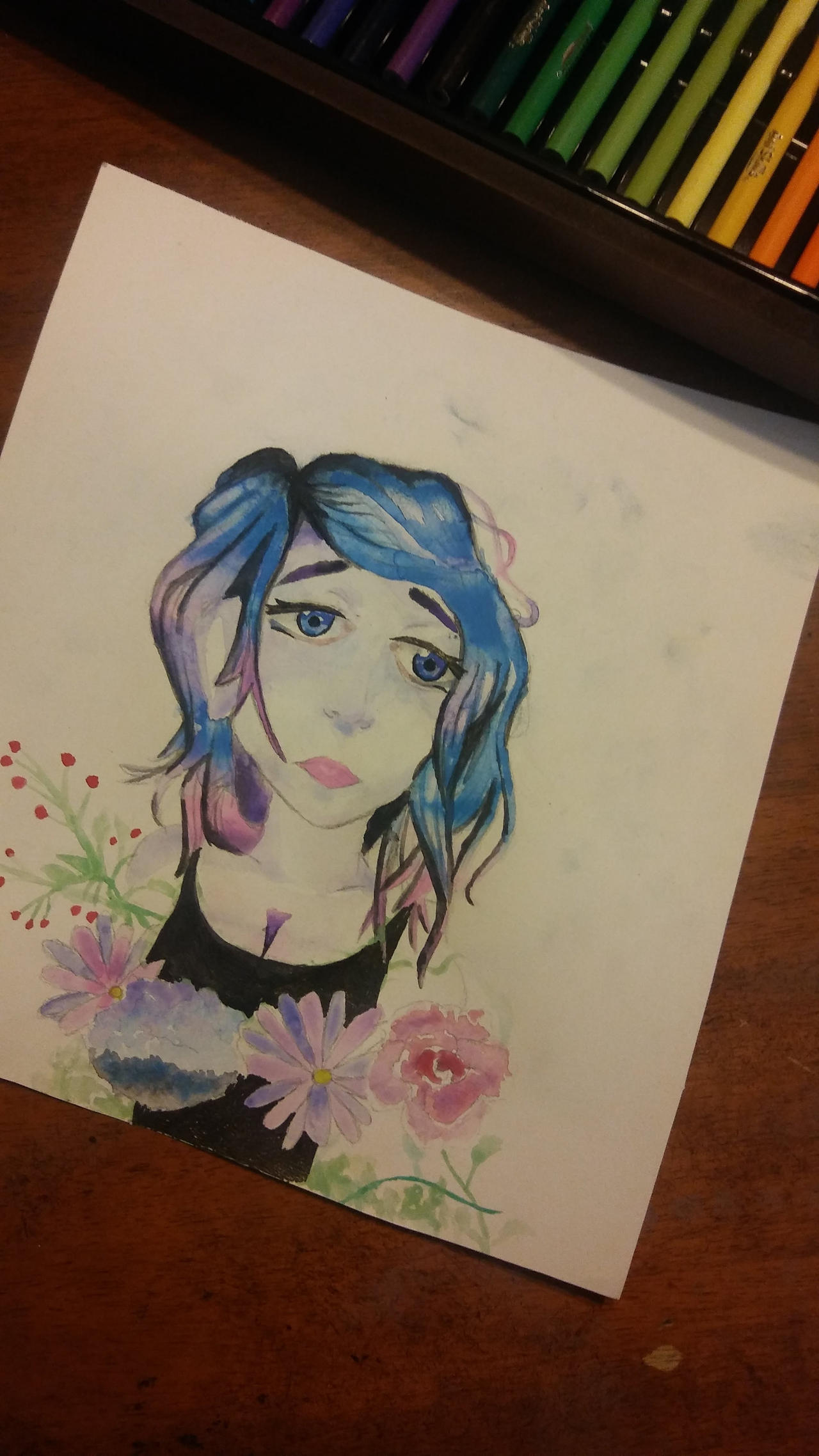 | Top-down photo | Traditional media texture ref (paper, pigment) | #2A6FB4 #B07BC4 #EADFD7 | Real desk lighting; great for texture cues | © artist; check page license |
| R20 | Character design-sheet news example | (press) | https://www.animeherald.com/2017/07/08/five-violet-evergarden-character-visuals-hit-web/ | — | N/A | Meta reference: locating official sheets | N/A | N/A | Press page; images remain copyrighted |
Design analysis
The analysis is structured around six style categories, each described as a modular “design system” you can remix. Each subsection points to relevant reference IDs for concrete visual anchors.
School uniform blue
The school-uniform approach often reads as “blue dress” through blue-coded elements (hair, trim, socks, skirt) even when the base garment has neutral tones. This category excels at silhouette stability: straight torso, simple skirt volume, minimal accessories, and strong graphic lines that animate cleanly. In R01, the uniform’s readability comes from a limited value range and crisp edges appropriate for production art.
Design motifs:
- High-contrast collar/cuff shapes to frame the face/hands.
- Pleat rhythm (even spacing) to carry motion without noisy folds.
- Small accent block (bow, tie, piping) to break monotony.
Fantasy gown and “Cinderella” ball silhouette
The fantasy-gown category is “blue dress at maximum drama”: big skirt volume, exaggerated hem arcs, and a bodice that acts as a visual anchor. R13 is explicitly framed as a “poofy” ball dress reference, which is useful for testing how far you can push silhouette while keeping the character’s head/face readable.
Design motifs:
- Princess/A-line silhouettes with broad hem (strong negative space under skirt).
- Accents in gold/cream to keep blue from flattening (also implies “royal”).
- Clean neckline design (sweetheart, off-shoulder) to avoid clutter at the face.
Casual summer dress and fit-and-flare
A casual summer version tends to compress details: fewer layers, simpler seams, and a lighter fabric read (cotton/linen vs satin). R05 exemplifies a “minimal-seam” sleeveless fit-and-flare where the dress reads primarily via shape + hue, not trim complexity.
Design motifs:
- Sleeveless or thin strap designs to keep the silhouette airy.
- One “gesture fold” cluster at the waist/hip; avoid over-rendering.
- Soft gradients or light rim highlights to suggest thin fabric.
Maid outfit as blue-dress-adjacent layering system
Even when the base maid dress is not blue, maid designs are structurally valuable because they are a masterclass in layer readability (dress + apron + lace + headpiece). R04 shows the common “black base + white apron + high-frequency frill edges” system; you can convert it into a blue dress by swapping the base color to navy/cobalt while keeping the apron white.
Design motifs:
- Lace/ruffle frequency as a “detail slider” (higher frequency reads more ornate).
- Apron as a high-contrast shape that keeps the torso readable.
- Headpiece/hair ornaments that echo apron shapes (visual cohesion).
Gothic / lolita blue
Lolita variants often use historical silhouette cues (high waistlines, layered skirts, structured bodices) plus high-detail trims. R06 (a photo reference) is particularly useful for the “how does it actually hang?” question: the tiered ruffles create predictable shadow bands, and plaid scale affects perceived body size.
Design motifs:
- Repeated trim bands that create strong rhythm when the character turns.
- Textures (plaid, lace) treated as *materials first*, not decoration.
- Shoes/socks that echo the dress’s pattern density (keep it consistent).
Futuristic blue dress and blue-coded uniform dressing
A “futuristic” variant usually shifts from lace/ruffle complexity toward hard edges and graphic paneling: clean seam lines, modular panels, reflective synthetics, and neon accents. When you don’t have a perfect single reference, build this category by combining:
- a clean production silhouette (R17) with simplified panels,
- a high-chroma accent strategy (see palettes below), and
- pose/lighting that sells material (rim light + sharp spec).
Design motifs:
- Seam lines that follow anatomy (sternum → ribcage → hips), almost like armor.
- Emissive accents (cyan rim, magenta edge) used sparingly.
- Fabric read: synthetic = sharper highlights and narrower spec bands.
Cross-category motifs that repeatedly show up
Silhouette archetypes:
- Fit-and-flare (clear waist, readable motion) — see R05.
- Layered skirt (ornate, “statement” costume) — see R06.
- Cape/capelet overlays (adds movement without changing base dress) — see R02.
Accessory language:
- Brooch/pendant at collarbone to anchor the face-to-costume transition (e.g., R03’s distinct chest accent).
- Hair ornaments that “repeat the dress motif” (bows, flowers, lace).
Fabric rendering tendencies (anime-adjacent):
- Dark blues often require edge lighting or trim to avoid reading as a flat mass; official sheets solve this by adding light trim, while illustrations solve it by adding spec and rim.
Pose, camera, and lighting reference
The goal here is a compact “pose library” that covers the most common production needs: turnarounds, key art, UI portraits, and action/gesture variants. Use this as a shot list for your own reference collection (stock photos, 3D mannequins, self-photo).
Pose set with camera and light
| Pose ID | Pose concept | Camera suggestion | Lighting setup | Notes for blue-dress readability |
|---|---|---|---|---|
| P01 | Neutral standing (front) | 50–85mm equivalent, eye-level | Flat key + soft fill | Perfect for costume sheet consistency; test silhouette |
| P02 | Neutral standing (back) | Same as P01 | Same | Validate bow placement, back seams, zipper logic |
| P03 | 3/4 contrapposto | 50mm, slight down-tilt | Soft key at 45° | Separates torso vs hips; creates clean S-curve |
| P04 | Skirt pinch / hem hold | 35–50mm, waist-level | Key + gentle rim | Shows fabric thickness and fold hierarchy quickly |
| P05 | Twirl / skirt flare | 24–35mm, slightly low angle | Back rim + top key | Best stress test for pleats/ruffles; avoid tangent-y hems |
| P06 | Seated, knees together | 50mm, slight down-tilt | Window light (one side) | Reveals compression folds at waist and behind knees |
| P07 | Step forward (walking) | 35–50mm, eye-level | Key + bounce from ground | Shows swing of hem; good for casual dress |
| P08 | Over-shoulder glance | 85mm portrait | Split lighting (key + minimal fill) | Great for “mood” key art; highlights collar/neckline |
| P09 | One-hand-on-hip | 50mm, eye-level | Key 45° + fill | Clarifies waistline and bodice structure; easy hero pose |
| P10 | Running start (action) | 24–35mm, low-ish | Strong rim + directional key | Fabric read via stretch lines; keep skirt as one gesture mass |
| P11 | Lean on prop (railing/chair) | 50mm, slight down | Soft ambient | Adds narrative; reveals dress tension points at hip/arm |
| P12 | Jump / airborne (stylized) | 24–35mm | Hard key + rim | Use for “futuristic” or magical variants; emphasizes silhouette |
Lighting “recipes” worth repeating
- Production sheet lighting: flat key + high fill → clean color reads, minimal shadow noise (see R01–R04).
- Cinematic soft daylight: slightly warm key + atmospheric haze → romantic, story-driven mood (see R03).
- High-contrast rim: a bright rim is the fastest way to keep deep navy readable as “blue” rather than “black” (useful when you push saturation down).
Color, lighting, and rendering guidance
Palette swatches
These are “ready palettes” you can drop into a design doc. Each palette includes a *blue core*, a *light*, a *dark*, and one *accent*.
| Palette | Hex swatch set | Best for | Mood / lighting suggestion |
|---|---|---|---|
| Naval Uniform | #1A2B4C #3B6EA8 #F4F0E8 #8A1F2B #C7A04A | School / uniform | Flat key + crisp edges |
| Cinderella Satin | #2F78D6 #6CB8FF #EAF4FF #F7D374 #FFFFFF | Ball gown | Soft top key + mild bloom |
| Icy Moonlight | #1F4E79 #A6D8FF #E6F7FF #DDE1E6 #F3E1A0 | Fantasy / magical | Cool key + warm accent rim |
| Coastal Summer | #2A7CCB #9FE3FF #E9FBFF #F2C6D0 #8AD4B1 | Casual sundress | Overcast daylight / soft shadows |
| Gothic Indigo | #1B144A #3A2D72 #E7E3F2 #0B0A0D #B08AE6 | Gothic lolita | Low-key with lace highlights |
| Teal Royal | #0F3F5E #1E6C8F #F7F4EF #D9C8A0 #2C1E1A | Court/fantasy | Warm key + gold bounce |
| Neon Sci-Fi | #142033 #0AE1FF #2B66FF #FF2DD6 #B5FF1E | Futuristic | Hard rim + emissive accents |
| Denim Plaid | #2B5E8F #6FAED4 #F7F7F7 #A22A2A #1C1C1C | Lolita/plaid | Indoor warm ambient + soft falloff |
Rendering cues that specifically help “blue dress” read
- Treat dark blue as value-first: establish the silhouette read in grayscale before piling on saturation. Official sheets succeed because edges and trims remain legible even with simplified shading.
- Reserve the sharpest speculars for one “material statement” area (satin bodice, glossy ribbon) so the dress looks intentional rather than uniformly shiny (contrast strategy visible in stylized illustration references).
- If you use patterned fabric (plaid), ensure the pattern scale supports the character’s scale; R06 is a practical reminder that ruffle tiers create strong horizontal banding and can widen the silhouette.
Technical, legal, and workflow notes
Digital painting techniques and layer breakdown
A production-friendly layer stack for a blue dress (works for both anime-cel and painterly):
- Silhouette flats: single-color blocks for skin/hair/dress/accessories.
- Material separation masks: separate layers for (a) matte fabric, (b) satin/shine, (c) lace/trim, (d) metal/jewelry.
- Value pass: shadows in one unified layer (multiply/linear burn), keeping fold shapes broad.
- Specular pass: narrow highlights for satin/synthetic; broader, softer highlights for cotton.
- Edge control pass: sharpen only where you need attention (face, neckline, hands, key trim).
- Lighting FX: rim light, bloom, particles (only if genre supports it).
Brush/texture recommendations (tool-agnostic):
- Use a hard brush for seam lines and trim edges; a soft brush for large fabric gradients; and a grain/noise overlay for subtle material breakup (especially on large flat blue areas).
- For lace, avoid drawing every scallop: imply lace density by alternating *solid* and *broken* edge segments (reads as lace at distance).
Common pitfalls (and how the references avoid them):
- Navy becoming “black”: solve with rim light and/or light trim edges (official sheets and maid designs rely heavily on edge contrast).
- Over-rendered folds: for anime readability, pick 3–6 major fold groups; let the rest be implied (R05 stays readable because the form is not over-fussy).
- Pattern noise: plaid/prints can destroy silhouette; control pattern frequency and keep it subordinate to the big shapes (R06 shows how strong ruffle tiers already add complexity, so pattern must be managed).
Legal and ethical considerations
Default assumption: most official anime images and many artist works are copyright-protected; use them for study and inspiration, not direct copying or redistribution. Official character visuals used here are presented as reference anchors, not reusable assets.
Best practices for attribution and derivative work:
- Track the artist name + source URL in your reference library (as in the table).
- If you publish designs influenced by a specific work, credit inspiration broadly (e.g., “inspired by gothic-lolita silhouettes”), and never reproduce distinctive, identifying design combinations wholesale.
- Avoid training your design on one image; instead, synthesize from multiple references and real-material studies (illustration + cosplay/photo).
A useful exception example: **** provides high-resolution PNG illustrations explicitly stated as usable for school assignments, hobby crafts, and even monetized ventures, with conditions such as maintaining aspect ratio and not flipping images. This is a rare case where permissive usage is spelled out clearly, making it valuable for legal-safe moodboards or studies.
Research workflow diagram and 3-day schedule
flowchart TD A[Define goal: anime girl + blue dress] --> B[Collect candidate refs] B --> C{Source tier} C --> D[Tier 1: official sheets / artbooks] C --> E[Tier 2: original artists (portfolio + socials)] C --> F[Tier 3: photo refs (pose + fabric)] D --> G[Tag: silhouette, seams, trims, accessories] E --> G F --> H[Tag: pose, camera angle, light direction] G --> I[Extract palettes + motif notes] H --> I I --> J[Deliver: curated table + pose set + palettes + workflow notes]Three-day deliverables timeline (compact, production-oriented):
| Day | Output | What you do | Acceptance criteria |
|---|---|---|---|
| Day 1 | Reference intake + tagging | Gather 60–120 candidates, prune to 20 “hero refs,” tag each with silhouette/material/lighting | 20 references have complete metadata + URLs |
| Day 2 | Style breakdown + pose library | Build 6+ style categories and 12-pose shot list; draft lighting recipes | Categories are distinct; poses cover sheet + key art + action |
| Day 3 | Palette + technical synthesis | Produce 8 palettes, refine notes, and create a “do/don’t” checklist | Palettes usable as-is; pitfalls + solutions documented |