Chinese AI Model Delays Under U.S. Compute Controls: Z.ai and Moonshot AI
Executive summary
Assessment: The claim that U.S. export controls are delaying the next generation of models at China’s Z.ai and Moonshot AI is credible and increasingly well supported, but only partly verified at the company-specific schedule level. The strongest public evidence is not the anonymous reporting about release dates; it is the combination of a new U.S. rule explicitly restricting Chinese companies’ remote access to large overseas clusters of controlled U.S. accelerators, a reported cancellation by Moonshot of a $150 million Indonesian Nvidia B300 compute contract immediately after that rule, Moonshot’s documented search for Blackwell capacity in Europe, and both companies’ own technical disclosures showing that frontier-scale models depend on large, high-bandwidth accelerator clusters. [1]
Reuters reported on November 26, 2026 that Z.ai had intended to release a roughly 3-trillion-parameter “GLM-5.5” in November but had slipped behind schedule, while Moonshot internally expected that loss of overseas compute could lengthen its approximately six-month flagship-model cadence to 12 months or more and push “Kimi K4” toward mid-2027. Those schedule claims rely on unnamed sources; neither Z.ai nor Moonshot confirmed them to Reuters. Z.ai instead released GLM-5.4 on November 23 and said only that a “significantly larger” successor would be ready “soon.” Moonshot’s public product line likewise remains active: it released the 2.8-trillion-parameter Kimi K3 in July and Kimi K3.1 Pro in October. Thus, the evidence supports a delay to the next major scaling step, not a generalized halt in model development. [2]
The causal story is also more complex than “export controls caused the delay.” Reuters’ sources attributed part of the slowdown to stronger countermeasures by U.S. model providers against unauthorized model distillation. Anthropic separately says it detected large-scale campaigns attributable to Moonshot and Zhipu, although those are Anthropic’s allegations rather than adjudicated findings; Moonshot has publicly rejected the suggestion that Kimi K3’s capability gains came from distillation, saying they resulted from original architectural work. Chinese regulators reject U.S. distillation allegations more broadly as unsupported and politically motivated. [3]
The November 19, 2026 Commerce/BIS rule is nevertheless a material new constraint. It requires authorization where controlled advanced-computing hardware in a data center anywhere in the world will provide more than 12,000,000 aggregate TPP to companies headquartered, or with ultimate parents headquartered, in Macau or U.S. Country Group D:5 destinations, including China; digitally linked data centers can be aggregated. Existing relevant arrangements receive a transition period in which operators must obtain authorization or terminate covered access. BIS says the purpose is specifically to stop restricted actors from circumventing chip controls by remotely renting computing power abroad. [4]
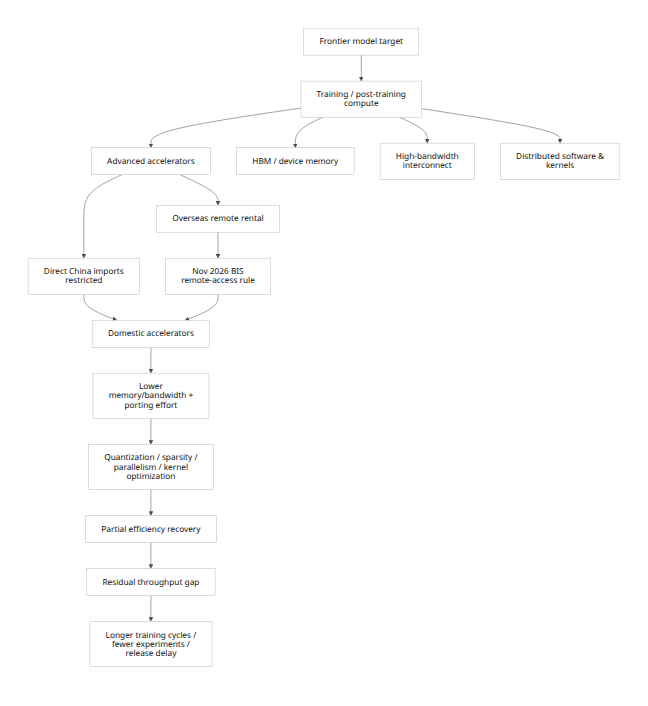
Technically, compute scarcity is fully capable of producing multi-month model delays. Large-model training requires not merely a nominal number of processors but sustained effective throughput across accelerators, high-bandwidth memory, high-speed interconnects, networking, software kernels, schedulers and fault-tolerant distributed training. Z.ai itself says that its deployment of more than 100,000 Chinese-made accelerators encountered comparatively limited memory and bandwidth and immature software support; Moonshot recommends 64-plus-accelerator high-bandwidth “supernodes” even for efficient K3 inference and says it developed K3 under “not abundant” compute conditions. Architectural efficiency, sparsity, quantization and model/expert parallelism can stretch available compute substantially, but they cannot remove the requirement for large aggregate training throughput. [5]
Bottom line: confidence is high that U.S. policy has sharply tightened Moonshot’s and Z.ai’s access to the most capable U.S.-origin compute; high for a concrete Moonshot procurement disruption, moderate-to-high that this is constraining frontier training at both companies, medium for the specific GLM-5.5 and Kimi K4 timetable claims, and low-to-medium that export controls alone explain those delays. The most defensible interpretation is a multi-factor slowdown: restricted foreign compute + domestic hardware/software limitations + tighter distillation defenses + the intrinsic difficulty of scaling toward multi-trillion-parameter frontier models. [6]
What is verified, and what remains reported
| Claim | Best evidence | Status | Assessment |
|---|---|---|---|
| Z.ai’s next model is behind its internal schedule | Reuters, citing two people familiar with the matter | Reported, not officially confirmed | Medium confidence. Z.ai did not comment; its Nov. 23 GLM-5.4 post says only that a much larger successor is coming “soon.” [7] |
| The delayed model is “GLM-5.5,” ~3T parameters, originally planned for Nov. 2026 | Reuters anonymous sources | Unverified internal detail | Medium/low-medium confidence. No Z.ai public document located confirms that name, parameter count or former release date. [8] |
| U.S. remote-compute restrictions could push Z.ai’s next flagship into Q1 2027 or later | Reuters source | Forward-looking estimate | Plausible, but not independently verifiable. Z.ai is also already on the BIS Entity List, magnifying its exposure to U.S.-origin technology restrictions. [9] |
| Moonshot believes a loss of overseas compute could stretch major releases from ~6 months to ≥12 months | Reuters source familiar with Moonshot operations | Reported internal expectation | Medium confidence; Moonshot did not comment. [10] |
| Kimi K4 could move to around mid-2027 | Reuters source estimate | Unverified forecast | Medium/low-medium confidence; no public K4 schedule from Moonshot was located. [10] |
| Moonshot cancelled a $150m Indonesian Nvidia B300 compute contract because of the new U.S. rule | The Information, citing two people with direct knowledge | Strongly reported, not company-confirmed | High confidence relative to other internal claims because the report identifies a concrete contract, hardware class and immediate policy trigger. Moonshot declined comment. [11] |
| Moonshot sought large Blackwell clusters in Europe | CNBC reporting; later corroborated by Reuters | Strongly reported | High confidence. Talks reportedly involved clusters of 8,000+ GPUs, primarily for inference but with interest in training. [12] |
| Both companies have genuine domestic-chip alternatives | Company technical disclosures | Verified, with caveats | Yes for deployment/inference. Z.ai says it operates production inference on >100,000 Chinese accelerators; this does not demonstrate one-for-one substitutability for frontier pretraining. [13] |
| Compute limits are technically capable of causing schedule delays | Company disclosures + distributed-systems requirements | Strong technical basis | High confidence. Both labs explicitly discuss compute, memory, bandwidth and communication constraints and efficiency workarounds. [14] |
| Distillation countermeasures are also contributing | Reuters + Anthropic | Plausible but contested | Anthropic documents campaigns it attributes to Moonshot/Zhipu; Moonshot disputes that K3’s gains were obtained via distillation. Attribution and legal characterization remain contested. [15] |
The distinction between directly observed policy effects and anonymous estimates of model schedules is crucial. BIS’s rules, Z.ai’s Entity List status, Moonshot’s overseas-compute activity, and the companies’ technical compute constraints are independently documentable. The precise “GLM-5.5 in Q1 2027” and “Kimi K4 in mid-2027” outcomes are not. [16]
There is also counterevidence against an overly strong “Chinese frontier AI has stalled” interpretation. Z.ai released GLM-5.4 only three days before the Reuters story, while Moonshot released K3.1 Pro in October and describes it as its most capable 3T-class open-weight model to date. The likely impact is therefore on scale, cadence, cost and experimentation capacity, rather than on the ability to issue any model releases at all. [17]
Timeline of controls, procurement and model developments
The current bottleneck is the cumulative result of several rounds of U.S. controls rather than a single November 2026 action. The 2022 rules established advanced-computing and supercomputer restrictions; 2023 tightened the chip thresholds and circumvention provisions; 2024 added HBM and more semiconductor-manufacturing controls; January 2025 put Zhipu entities on the Entity List; and the November 2026 rule attacks the overseas-cloud/remote-compute route directly. [18]
| Date | Event | Relevance to Z.ai / Moonshot |
|---|---|---|
| Oct. 7–21, 2022 | BIS introduces controls on advanced computing chips, computers containing them, supercomputer end uses, semiconductor-manufacturing items, and certain U.S.-person support. Advanced-computing controls become effective Oct. 21. [19] | Establishes the core barrier to directly importing top U.S. AI accelerators into China. |
| Oct. 17 / Nov. 16, 2023 | BIS tightens advanced-computing thresholds, introduces performance-density criteria and worldwide anti-circumvention requirements for companies headquartered in arms-embargoed destinations. It removes “interconnect bandwidth” as a chip-control parameter. [20] | Makes reduced-spec chip workarounds and third-country procurement more difficult. |
| Dec. 2, 2024 | BIS adds controls on high-bandwidth memory, 24 classes of semiconductor-manufacturing equipment, three software categories, and 140 Entity List additions. [21] | HBM is a direct AI-accelerator bottleneck; manufacturing controls impede domestic substitution at the leading edge. |
| Jan. 15–16, 2025 | BIS adds Beijing Zhipu Huazhang Technology and related Zhipu entities to the Entity List, with licensing required for all EAR-controlled items and a presumption of denial. [22] | Z.ai faces a stricter company-specific restriction than Moonshot. |
| Jan. 2, 2025 onward | Treasury’s Outbound Investment Security Program becomes effective for certain U.S. investments involving Chinese semiconductor, quantum and AI activities. [23] | Primarily a financing/investment constraint, not the legal mechanism restricting GPU access. |
| July 2026 | Moonshot releases Kimi K3, a 2.8T MoE model; its own Chinese-language technical post says the model was developed under “not abundant” compute and achieved about 2.5× scaling efficiency through architectural and infrastructure improvements. [24] | Direct primary-source evidence that compute efficiency is already a strategic constraint. |
| July 21, 2026 | Moonshot business executive Huang Zhenxin tells National Business Daily that K3’s gains came from original architectural innovation, rebutting external distillation claims. [25] | Company response to one alternative explanation for rapid capability gains. |
| Sept. 2026 | Anthropic publishes a threat report attributing unauthorized distillation campaigns to several PRC labs, including Moonshot and Zhipu. [26] | If anti-distillation defenses reduce access to frontier-model outputs, Chinese labs lose another potential efficiency shortcut. |
| Sept. 17, 2026 | Z.ai says it operates GLM-5.3-Flash production inference on >100,000 Chinese-made accelerators, but describes limited memory/bandwidth and immature software support. [27] | Demonstrates both substantial domestic substitution and its engineering cost. |
| Oct. 2026 | Moonshot releases Kimi K3.1 Pro with larger post-training compute. [28] | Shows model iteration continued shortly before the latest U.S. rule. |
| Nov. 5, 2026 | CNBC reports Moonshot sought European Blackwell capacity, with discussions involving 8,000+ GPU clusters. [29] | Evidence that foreign compute was operationally important before the new rule. |
| Nov. 16 / 19, 2026 | BIS issues, then brings into force, the remote-access IFR targeting large overseas compute allocations to Chinese and other D:5-headquartered firms. [30] | Directly closes the overseas-rental pathway. |
| Nov. 17, 2026 | China’s Commerce Ministry says it “strongly” opposes the measure and warns of countermeasures. [31] | Signals likely diplomatic and regulatory escalation. |
| Nov. 19, 2026 | The Information reports Moonshot cancelled a $150m Indonesian B300 cluster contract following the U.S. rule. [32] | Strongest concrete evidence of immediate company-level procurement disruption. |
| Nov. 23, 2026 | Z.ai releases GLM-5.4, based on a 750B foundation with a Loop Transformer, and promises a “significantly larger” model “soon.” [33] | Consistent with continued innovation, but also with a larger planned model having slipped. |
| Nov. 26, 2026 | Reuters reports GLM-5.5 and Kimi K4 schedule slippage from unnamed sources. [8] | First direct report tying internal next-generation schedules to compute restrictions and anti-distillation measures. |

The November IFR is qualitatively important because it moves U.S. regulation from controlling where a chip is shipped toward controlling certain end uses of that chip after shipment, including the remote computing capacity it supplies. BIS explicitly includes digitally linked data centers and requires authorization above the 12 million aggregate-TPP threshold for covered Chinese/D:5 users. CSIS estimates that threshold at roughly 750 H200 GPUs or approximately 42 Vera Rubin accelerators; those GPU equivalents are analytical conversions, not numbers written into the regulation itself. [34]
The compute bottleneck and technical feasibility of delay
What resources are actually constrained
The U.S. controls reach several layers of the frontier-AI stack. They cover qualifying advanced GPUs/AI accelerators, computer systems and servers containing them, related controlled software and technology, and—through separate rules—critical upstream inputs such as HBM and semiconductor-manufacturing equipment. The 2026 remote-access rule applies to specified advanced-computing items used in data centers; the 2022 rule had already controlled high-performance chips and computers containing them. [35]
Interconnects require more nuance. BIS removed “interconnect bandwidth” as a parameter for deciding whether an individual chip meets the advanced-computing threshold in the 2023 update. That does not make networking irrelevant: high-speed links, switches and topology are essential to actual cluster performance, and the 2026 rule explicitly aggregates digitally linked infrastructure for the remote-access threshold. Z.ai reports a 19% inference-throughput gain when one network configuration was increased from 100 to 200 Gbps, illustrating how communication can become a first-order bottleneck. [36]
Why fewer top-tier accelerators can translate into months of delay
For a fixed model, dataset and optimization recipe, reducing effective training throughput increases wall-clock training time. At frontier scale, however, the impact can be worse than a simple inverse-GPU-count relationship because distributed efficiency falls when work must be spread over slower chips, weaker interconnect domains or less mature software. Large MoE models add substantial all-to-all communication; long contexts increase memory pressure; hardware failures and checkpoint/restart overhead become more consequential as cluster size grows. Moonshot’s K3 documentation explicitly describes expert-parallel balancing as a critical large-scale training problem and recommends high-bandwidth domains of at least 64 accelerators for efficient inference. [37]
Z.ai’s domestic deployment offers unusually concrete evidence of the substitution penalty. The company says its >100,000-accelerator Chinese cluster initially faced limited device memory and bandwidth, incomplete kernel support and an immature ecosystem. It compensated with tensor parallelism, quantization, cache compression, layer splitting and a disaggregated encode/prefill/decode architecture, ultimately tripling inference throughput. This demonstrates that domestic hardware can be engineered into very large systems, but it also shows why “just use Chinese chips” is not equivalent to swapping identical Nvidia accelerators into an existing training stack. [27]
Moonshot’s own July statement is similarly revealing: despite K3 having about 2.8 trillion total parameters, it says KDA, Attention Residuals, MoE sparsity and MoonEP raised its “scaling efficiency” by about 2.5× under comparatively constrained compute conditions. Such techniques reduce the compute needed for a given capability level; they do not make aggregate compute irrelevant. A company trying to move from K3 to a materially more capable K4 must still buy additional capability through some mix of more training FLOPs, better data, better algorithms and more post-training/RL compute. [38]
Workarounds and their limits
Domestic accelerators. Z.ai says GLM-5 can run on Huawei Ascend, Moore Threads, Cambricon, Kunlun, MetaX, Enflame and Hygon hardware, and its GLM-5.3-Flash serving stack runs entirely on Chinese accelerators. China’s industrial policy is moving in the same direction: the Ministry of Industry and Information Technology’s current planning calls for 10,000- and 100,000-plus-accelerator AI clusters and greater adaptation to domestic compute chips. This is the most durable workaround, but the public evidence is far stronger for inference and deployment than for replacing top Nvidia clusters in state-of-the-art multi-trillion-parameter pretraining. [39]
Overseas cloud/neocloud capacity. This was Moonshot’s clearest workaround and is precisely what the November rule targets. CNBC reported discussions for ≥8,000 Blackwell GPUs in Europe, while The Information reported the planned B300 cluster in Indonesia. The new end-use rule means that changing the country of the data center is no longer necessarily sufficient if the compute is ultimately being provided at scale to a Chinese-headquartered customer. [40]
Model parallelism and efficiency engineering. Tensor parallelism, expert parallelism, sparsity, quantization, low-memory attention designs, cache compression and Z.ai’s Loop Transformer all increase the useful intelligence obtained per accelerator or per byte of memory. Z.ai says GLM-5.4’s repeated, weight-shared layers increase effective depth without proportionally increasing parameters; Moonshot activates only 16 of 896 K3 experts. These methods can materially delay the point at which hardware scarcity becomes binding, but some—especially expert and tensor parallelism—also increase communication demands. [41]
Distillation. Distillation can reduce the amount of expensive native training or post-training needed by learning from a stronger model’s outputs, so stronger access controls and anti-abuse systems can increase the marginal compute/data burden on a lab. Anthropic says it observed more than 23 million exchanges in campaigns it attributes to Moonshot between May and July 2026 and more than 3.4 million exchanges attributable to Zhipu during 17 days in June and July. Those figures are Anthropic’s attribution; Moonshot disputes claims that K3’s performance came from distillation, and China’s Commerce Ministry says U.S. allegations of industrial-scale distillation lack factual and legal basis. [42]
A broader estimate illustrates why overseas compute mattered. The Institute for Progress estimates Chinese users could access roughly 1 million H100-equivalent GPUs remotely by the end of 2026, with about 75% of such capacity concentrated in Southeast Asia; it projects substantially more in 2027 absent stronger controls. These are model-based estimates with wide uncertainty, not government or company disclosures, but they explain why closing remote access can materially affect aggregate Chinese AI compute despite rapid domestic chip expansion. [43]
Procurement and supply-chain chokepoints
Moonshot provides the clearest procurement case. The Information reported on November 19 that it had agreed with a Southeast Asian neocloud to rent a sizable Nvidia Blackwell Ultra B300 cluster in Indonesia, with service potentially beginning in 2027, but abandoned the approximately $150 million arrangement after the U.S. remote-access rule was announced. The contract reportedly involved unusually aggressive commercial terms, according to subsequent reporting, consistent with a high willingness to pay for scarce frontier compute. Moonshot has not publicly confirmed the transaction. [44]
Earlier, CNBC reported that Moonshot was pursuing European neocloud or data-center arrangements involving at least 8,000 Blackwell GPUs, principally for inference with some interest in training. Reuters independently reported on November 26 that Moonshot had intensified its attempts to rent European capacity. Taken together, the Indonesia and Europe reports make it difficult to dismiss overseas Nvidia access as incidental to Moonshot’s strategy. [12]
For Z.ai, public evidence of a specific 2026 foreign procurement attempt is weaker. Its exposure arises instead from two structural facts: it is already an Entity List company, and its own engineering disclosures show extensive work to adapt models to domestic chips because advanced compute is scarce. The current BIS Entity List entry for Beijing Zhipu Huazhang Technology requires licenses for all items subject to the EAR under the applicable entry, with a presumption of denial. [45]
The supply-chain constraint also extends upstream. U.S. controls have increasingly targeted the capability to manufacture advanced accelerators inside China by restricting semiconductor manufacturing equipment, software and HBM. This matters because a domestic GPU is only a full substitute if China can supply leading-edge logic dies, large amounts of high-performance HBM, advanced packaging, networking and a robust software ecosystem at sufficient volume. BIS’s December 2024 package explicitly identified both advanced-node semiconductor manufacturing and HBM as targets. [21]
Chinese policy is responding at system scale rather than merely at the individual-chip level. MIIT’s 2026 planning documents call for integrated national compute networks, 10,000- and 100,000-plus-card intelligent-computing clusters, more domestic-chip adaptation, and high-end optical and switching technology development. This can reduce vulnerability over time but also underscores that networking, memory, scheduling and cluster integration—not only chip arithmetic throughput—are strategic bottlenecks. [46]
Company, market and financial implications
Z.ai
Z.ai is financially better positioned to absorb expensive engineering work than it was before its January 2026 Hong Kong listing, but it remains heavily loss-making. Its official first-half 2026 filing reported revenue of RMB953.9 million, up 399.7% year over year; R&D expense of RMB2.13 billion; and a net loss of roughly RMB2.07 billion. In September it completed a major capital raise including RMB20.14 billion of zero-coupon convertible bonds, alongside a share placement. These figures indicate considerable capacity to fund model development, but export controls create a constraint that capital alone cannot necessarily solve: money does not guarantee lawful access to controlled accelerator clusters. [47]
Z.ai’s shares have also been extremely volatile around the latest policy and model news. They closed at HK$359.80 on November 19, HK$340.20 on November 23, HK$271 on November 25 and approximately HK$293 on November 26. It would be inappropriate to attribute those moves specifically to the Reuters delay report or the BIS rule because several simultaneous catalysts existed, including GLM-5.4, capital-market developments and broader Chinese AI-sector sentiment. The observable market fact is volatility; a clean causal “export-controls discount” is unspecified. [48]
A sustained slowdown would matter disproportionately because Z.ai’s R&D expenditure already exceeds its reported half-year revenue. Longer training runs, more failed experiments, hardware-porting teams and duplicated stacks for Nvidia and domestic accelerators would raise the cost of staying at the frontier even if inference economics continue to improve. The magnitude of incremental training cost and Z.ai’s internal GLM-5.5 budget are not public. [49]
Moonshot AI
Moonshot remains privately held, so audited public financial statements, cash balance, training budgets and Kimi K4 development costs are unspecified. Bloomberg reported in July that Moonshot raised about $3.5 billion at a $35 billion valuation and was considering a later round at a much higher valuation, but those figures were based on people familiar with the private financing and should not be treated like audited filings. [50]
Operational indicators suggest rapid commercialization: Moonshot executive Huang Zhenxin told National Business Daily that API revenue had risen 400% year over year, and the publication reported annual recurring revenue above $300 million by mid-June. The same reporting documented a July compute-capacity squeeze after K3 demand exceeded forecasts, forcing Moonshot temporarily to prioritize existing paying customers. These are useful indicators of demand but do not provide sufficient data to calculate profitability or runway. [51]
The cancelled $150 million Indonesia agreement is potentially material because it represents not just lost hardware access but a strategic procurement failure: scarce future training capacity that management apparently considered worth locking in ahead of time. If equivalent lawful capacity cannot be obtained, Moonshot faces a three-way trade-off among slowing frontier training, accepting lower-performing hardware, or spending more engineering effort on efficiency and domestic-chip adaptation. [52]
Regulatory, geopolitical and competitive implications
The immediate legal risk falls heavily on exporters, reexporters, data-center operators and neoclouds handling controlled items. Under the new BIS framework, a provider that knows covered hardware will supply more than the specified aggregate compute to a covered Chinese/D:5 company can require authorization even though the physical servers remain outside China. The regulation also imposes customer-identification and notification obligations and contemplates enforcement where data-center allocation changes after shipment. This increases compliance costs and creates a strong incentive for providers to over-comply rather than test ambiguous arrangements. [53]
Z.ai has an additional layer of risk because its relevant entities remain on the BIS Entity List. Moonshot is not identified in the current official BIS material reviewed for this report as having the same existing Entity List status; therefore its direct legal position differs. U.S. officials have publicly discussed potential sanctions or Entity List action in connection with alleged distillation activity, but a threat or investigation should not be conflated with an actual designation. [54]
Treasury’s role is distinct. Its current Outbound Investment Security Program restricts or requires notification for certain U.S.-person investments into Chinese entities active in covered semiconductor, quantum and AI activities; it does not operate as the primary export-control mechanism governing Moonshot’s rented GPUs. Treasury issued its first civil penalty under that program in 2026, indicating that the regime is actively enforced, while an October 2026 proposed rule under the COINS Act would update the framework further. [55]
China has responded both rhetorically and industrially. On November 17, the Ministry of Commerce called the remote-access measure an abuse of export controls that interferes with normal commercial cooperation and threatens semiconductor supply-chain stability, and warned that China could take countermeasures. Separately, Beijing’s domestic policy increasingly emphasizes indigenous AI chips, very large accelerator clusters, integrated national compute scheduling and public-cloud capacity. [56]
The strategic effect is therefore ambiguous over longer horizons. In the short run, the controls raise the cost and time required for Chinese labs to reach the frontier by restricting the easiest route to Nvidia-scale compute. Over a longer horizon they also strengthen incentives for China to replace Nvidia, CUDA-centric infrastructure, foreign HBM and U.S.-linked clouds with an indigenous stack. Z.ai’s >100,000-accelerator deployment is early evidence that this adaptation process is already occurring, even though the company itself acknowledges the resulting memory, bandwidth and software difficulties. [57]
| Risk / implication | Likelihood | Potential impact | Horizon | Evidence assessment |
|---|---|---|---|---|
| Moonshot loses or delays access to frontier Nvidia clusters abroad | High | High | Immediate–12 months | Concrete Indonesia cancellation plus Europe procurement effort and new BIS rule. [58] |
| Z.ai next-generation flagship slips further | Medium–High | Medium–High | 3–9 months | Reuters internal sourcing; Z.ai confirms larger successor but not timetable. [7] |
| Kimi K4 release moves to mid-2027 or later | Medium | High | 6–12 months | Anonymous internal estimate only; no Moonshot confirmation. [10] |
| Domestic accelerators substitute for U.S. GPUs at inference scale | High | Medium/positive | Current | Z.ai has already demonstrated >100k-chip production inference. [27] |
| Domestic accelerators fully eliminate frontier-training bottleneck | Low–Medium | Very high if achieved | 1–3 years | Existing disclosures show memory/bandwidth/software penalties; no public demonstration of seamless equivalence. [59] |
| Neoclouds/data centers reduce service to Chinese AI labs through over-compliance | High | High | Immediate | Rule creates direct licensing/KYC exposure for providers. [34] |
| U.S. distillation countermeasures further raise Chinese training/post-training costs | Medium–High | Medium | Current–12 months | Anthropic reports major campaigns; causal contribution to specific model delays remains anonymously sourced and disputed. [60] |
| Moonshot faces additional U.S. designation/sanctions risk | Medium | Very high | 6–24 months | U.S. officials have raised the possibility; no current designation verified here. [61] |
| U.S. investment restrictions constrain financing | Medium | Medium | 1–3 years | Treasury regime is active and proposed COINS implementation could broaden risk; Moonshot’s actual U.S.-person financing exposure is unspecified. [62] |
| Chinese countermeasures intensify technology fragmentation | Medium–High | High | 1–3 years | MOFCOM explicitly threatens countermeasures while industrial policy accelerates domestic substitution. [63] |
| Controls permanently stop Chinese frontier-model competition | Low | Very high | Multi-year | Current evidence shows slower/expensive adaptation, not cessation; Z.ai and Moonshot continue shipping frontier-class models. [17] |
From an AI-competition perspective, the most important metric may ultimately be experimentation throughput rather than a single training run. Frontier laboratories gain advantage by running many architecture ablations, data experiments, post-training trials and evaluation loops. A 20–40% effective compute deficit can therefore hurt not only the duration of one final training run but also the number of ideas a lab can test before committing to it. Z.ai’s and Moonshot’s aggressive efficiency engineering is a rational response: it raises intelligence produced per unit of scarce compute, but simultaneously makes software/hardware co-design an increasingly important competitive capability. This conclusion is an inference from the companies’ disclosed efficiency work and cluster constraints, rather than a published measure of their internal experimental throughput. [64]
Primary documents and original reporting
The most important original news report is Reuters, November 26, 2026, “US chip curbs, distillation crackdown threaten Chinese AI model development, sources say”. It is the source for the GLM-5.5 and Kimi K4 schedule claims, and it explicitly reports that neither company commented on those delay allegations. [8]
The strongest earlier procurement report is The Information, November 19, 2026, “China’s Moonshot AI Scraps $150 Million Deal to Access Nvidia Chips in Indonesia”, which cites two people with direct knowledge of the cancelled Blackwell Ultra B300 arrangement. CNBC’s November 5 original report is “Chinese AI lab Moonshot turned to Europe for Nvidia Blackwell access amid U.S.-China curbs”. [58]
The controlling U.S. primary source is the Commerce Department/BIS November 16 press release, together with the November 19 Federal Register interim final rule. Earlier primary milestones are BIS’s October 2022 controls, October 2023 strengthening measures, and December 2024 HBM/manufacturing package. [65]
For Z.ai, the most relevant company primary sources are GLM-5.4, its account of building inference infrastructure on more than 100,000 Chinese accelerators, and GLM-5, which identifies supported non-Nvidia accelerator families. The current BIS Entity List language can be checked directly in EAR Part 744. [66]
For Moonshot, the key primary sources are the Kimi K3 technical blog, the Chinese-language Kimi K3 open-source/technical release, and Kimi K3.1 Pro. The July 21 company rebuttal to distillation claims is recorded by Chinese financial newspaper National Business Daily in this interview with Moonshot executive Huang Zhenxin. [67]
For the Chinese government position, the Ministry of Commerce’s November 17 response to the remote-compute rule states China’s opposition and threat of countermeasures; its September response to U.S. distillation allegations rejects those claims. MIIT’s current planning calls for very large domestic AI clusters and broader adaptation of indigenous compute chips. [68]
For Treasury, the authoritative source is its Outbound Investment Security Program, under which the current rules took effect January 2, 2025. Treasury emphasizes that those rules remain in force pending regulations under the subsequently enacted COINS Act; the program is relevant to financing and investment risk, while Commerce/BIS remains the operative authority for the export- and remote-compute controls examined here. [69]
Finally, the two most useful independent analytical sources are CSIS’s November 18 analysis, which explains the mechanics and likely compliance effects of the remote-access rule, and the Institute for Progress’s October 2026 estimate of China’s overseas-compute exposure. Their quantitative GPU-equivalent estimates should be treated as analytical estimates rather than statutory or company-disclosed facts. [70]
References
- [1] [16] Federal Register, Volume 91 Issue 222 (Thursday, November 19, 2026)
- [2] [3] [7] [8] [9] [10] US chip curbs, distillation crackdown threaten Chinese AI model development, sources say
- [4] [34] [53] Addressing Remote Access to Advanced Semiconductors | 91 FR 74970
- [5] [13] [27] [57] [59] Toward Recursive Self-Improvement: How GLM Built Its Own Inference Infrastructure
- [6] [11] [32] [44] [52] [58] The Information
- [12] [29] [40] Chinese AI lab Moonshot turned to Europe for Nvidia Blackwell access amid U.S. China curbs, sources tell CNBC - CNBC | Internationly
- [14] [24] [38] Kimi K3 开放日:模型权重、技术报告和关键 Infra 技术同步开放
- [15] [26] Countering misuse of AI: September 2026 / Anthropic \ Anthropic
- [17] [33] [41] [64] [66] GLM-5.4: Toward Generalized Coding with Our First Loop Transformer
- [18] [19] [35] Bureau of Industry and Security
- [20] [36] Bureau of Industry and Security
- [21] Bureau of Industry and Security
- [22] [45] [54] EAR 744 | Bureau of Industry and Security
- [23] [55] [62] [69] Outbound Investment Security Program | U.S. Department of the Treasury
- [25] Kimi K3风暴第四日:月之暗面黄震昕回应争议,中国开源大模型打响定价权突围战 | 每日经济新闻
- [28] Kimi K3.1 Pro Tech Blog: Advancing Open Intelligence
- [30] [65] Bureau of Industry and Security
- [31] [56] [63] [68] 商务部新闻发言人就美商务部发布限制远程获取先进半导体相关措施答记者问
- [37] Kimi K3 Tech Blog: Open Frontier Intelligence
- [39] GLM-5: From Vibe Coding to Agentic Engineering
- [42] [60] Countering misuse of AI: September 2026 / Anthropic \ Anthropic
- [43] How to Increase America’s AI Lead Over China | IFP
- [46] 事关国产算力,重要部署→
- [47] [49] https://allenandgledhill-my.sharepoint.com/personal/huang_yiting_agasia_law/Documents/DLCs-SG issuer/260922_3 new issues(Giga_MiniMax_Z AI)/SLD/SG Issuer_DLCs_Long_SLD_3x_Z AI_260928_clean
- [48] Z.AI Co., Ltd. (2513.HK) Stock Historical Prices & Data - Yahoo Finance
- [50] Moonshot AI Surpasses Funding Goal to Hit $35 Billion Value - Bloomberg
- [51] Kimi K3风暴第四日:月之暗面黄震昕回应争议,中国开源大模型打响定价权突围战 | 每经网
- [61] China accuses US of 'AI hegemonism', threatens countermeasures over potential probes
- [67] Kimi K3 Tech Blog: Open Frontier Intelligence
- [70] New Export Controls on Remote Access: The Implications for Industry and Competition with China