Fact-check: India’s “Chariot AI” 11-billion-parameter foundation model
Executive summary
Verdict: substantially true, but the headline overstates what has been independently verified. An Indian company now operating as Chariot Artificial Intelligence Private Limited launched the Chariot-1 model suite at Bharat Mandapam in New Delhi on November 25, 2026; India’s Ministry of Electronics and Information Technology publicized the launch on November 26, 2026. The government describes Chariot-1 as an 11-billion-parameter mixture-of-experts large language model with about 4 billion active parameters per token, accompanied by a multilingual text-to-speech system. Chariot is indeed backed by the central government’s IndiaAI Mission. [1]
The startup name requires clarification. The company is not simply a newly selected entity called “Chariot AI.” Government records originally selected Gan AI in May 2025; Chariot is the successor/rebranded organization. A company-registry data provider reports that Chariot Artificial Intelligence Private Limited, CIN U62099UP2025PTC226753, was incorporated on June 25, 2025 and was previously named Gan Artificial Intelligence Private Limited; Chariot’s own site gives the same legal company name and Noida registered office. ThePrint independently describes Chariot as “formerly known as Gan AI.” I did not locate a directly accessible MCA certificate of name change, so the CIN and former-name relationship are well-supported but not independently verified against the underlying MCA filing itself. [2]
Government backing is unusually well documented. A February 2026 parliamentary/MeitY disclosure assigned Gan AI ₹110.03 crore of IndiaAI support, comprising ₹88.02 crore of compute support and ₹22.01 crore of non-compute cost support. The same program is part of the ₹10,371.92-crore IndiaAI Mission approved by the Union Cabinet in March 2024. [3]
What is not yet independently established is equally important. As of November 26, 2026, I found no public Chariot-1 LLM weights, model card, training-data inventory, architecture paper, training FLOP/GPU-hour disclosure, MMLU/HELM/lm-eval result, or independent LLM leaderboard entry. The government and company disclose the headline parameter count and several research techniques, but not enough information to reproduce or audit the LLM. Chariot’s speech benchmarks are substantially more detailed, but they are company-run evaluations rather than independent third-party testing. [4]
The strongest interpretation of the announcement is therefore: India has produced another domestically developed, government-supported foundation-model program with meaningful multilingual research and commercial speech products, but the evidence does not yet justify treating Chariot-1 as a fully open, independently benchmarked, or technologically self-sufficient sovereign LLM stack. India’s sovereignty gain is clearest at the model-development, data, talent, hosting and application layers; it remains constrained by dependence on foreign accelerator hardware and software ecosystems, including NVIDIA infrastructure. [5]
Identity, legal entity, and announcement
The exact legal entity cited by the Indian government is Chariot Artificial Intelligence Pvt. Ltd. Chariot’s own contact and legal pages use Chariot Artificial Intelligence Private Limited and list a registered office at A-90, Sector 2, Noida, Uttar Pradesh. Registry mirrors report CIN U62099UP2025PTC226753, incorporation on June 25, 2025, and an earlier corporate name of Gan Artificial Intelligence Private Limited. [6]
This resolves an apparent discrepancy in official sources. When MeitY announced the first group of IndiaAI foundation-model selections on May 30, 2025, it named Sarvam AI, Soket AI, Gnani AI and Gan AI; Chariot did not appear under that name. The same release said Gan AI would build a 70-billion-parameter multilingual foundation model targeting “Superhuman TTS.” In November 2026, MeitY instead identified Chariot as one of those first four teams, while ThePrint explicitly called Chariot “formerly known as Gan AI.” [7]
The public launch itself occurred on November 25, 2026. Chariot advertised a “Chariot One” launch and research showcase at Bharat Mandapam, with MeitY Secretary S. Krishnan scheduled to inaugurate the model. Chariot’s news page had announced the event on November 23. IndiaAI also promoted the launch beforehand on LinkedIn. [8]
The formal government announcement followed at 11:23 a.m. on November 26, 2026, when PIB/MeitY published “India AI Mission-supported Chariot-1 Foundation Models Launched.” Thus, reports dated November 26 refer to the government press release; the underlying launch event was November 25. [9]
There was also an earlier product release: Chariot-1-TTS-Multilingual was announced by Chariot on November 12, 2026, while Chariot-1-ASR Realtime had been released on October 22. Those speech products therefore predate the formal Chariot-1 foundation-model showcase. [10]
Claimed specifications versus verified evidence
| Item | Public claim | What the evidence supports | Assessment |
|---|---|---|---|
| Model name | Chariot-1 LLM | Confirmed by MeitY/PIB. [9] | Verified |
| Total parameters | “11 billion” | Government specifies an MoE model and separately gives the largest configuration as 10.7B parameters, reasonably rounded to 11B. [11] | Verified as rounded figure |
| Active parameters | 4B/token | Explicitly stated by MeitY. [11] | Verified as official claim; not independently measured |
| Architecture | Mixture-of-experts | Explicitly stated. Number of experts, routing scheme, layer count, hidden dimension, attention configuration and context length are not disclosed. [11] | Partially specified |
| Model sizes | 10.7B, 1.7B, 745M | Stated by MeitY. Chariot says “Nested Training” can produce three model sizes from one training run. [11] | Officially claimed; artifacts not public |
| Training origin | Pre-trained from scratch in India | Explicit MeitY claim. [9] | Officially verified, not independently reproducible |
| Training corpus | India-focused/multilingual | No Chariot-1 corpus inventory, token count, data-source list, language proportions, deduplication method or rights provenance was located. | Unspecified |
| Tokenization | IndicShift shared-alphabet approach | Government says IndicShift maps 1,012 characters across 12 Indian scripts to 350 shared letters and reports up to 2.5× fewer tokens than an OpenAI GPT tokenizer. [11] | Method described; independent replication absent |
| Tokenizer artifacts | IndicShift | Hugging Face’s model index showed newly uploaded chariot-ai/indic-shift-262k and chariot-ai/indic-shift-131k entries on November 26. I could not inspect their model cards or licenses through the available fetcher. [12] | Artifact existence indicated; license/details not verified |
| Training compute | Undisclosed | No Chariot-specific GPU type, node count, GPU-hours, FLOPs, energy use or training duration was published. Government support to Gan AI was valued at ₹88.02 crore for compute. [13] | Unspecified |
| Training framework | NVIDIA NeMo, at least for earlier Chariot TTS work | NVIDIA said in February 2026 that Chariot was developing an 8B real-time TTS model using NeMo. That does not prove the released 10.7B LLM uses exactly the same stack. [14] | Partial historical evidence |
| Model weights | Chariot-1 LLM downloadable weights | No public LLM weights were located on Chariot, Hugging Face or AIKosh in this review. [15] | Not verified / apparently unavailable |
| LLM API | Public Chariot-1 LLM API | Chariot publicly exposes speech APIs, but I found no documentation establishing a general-purpose Chariot-1 LLM API. [16] | Not verified |
| Speech API/demo | Chariot TTS/ASR | Public commercial access is documented. TTS supports web and API access and has rupee-denominated paid tiers. [17] | Verified |
Three technical ideas were highlighted at launch. IndicShift is the shared-script representation described above. Nested Training is claimed to train all three model sizes simultaneously using one set of weights and to be 62% faster than training them independently. Mixture of Vocabularies divides the vocabulary into 11 groups, scores only a relevant group during prediction, and is claimed to reduce the number of vocabulary entries scored per word by 5.7× while improving training speed by 38% on the same GPUs. These are intriguing engineering claims, but the current evidence is a government description of Chariot’s reported results rather than a peer-reviewed paper or independently reproduced study. [11]
A notable unresolved issue is the model’s evolution. In May 2025, Gan AI was selected to build a 70B “Superhuman TTS” foundation model. By February 2026 NVIDIA described Chariot as building an 8B real-time TTS model. The November 2026 launch describes a 10.7B/“11B” MoE LLM plus TTS, with smaller nested variants. No source I found explains whether the original 70B plan was abandoned, rescoped, converted to a sparse architecture, or remains a future target. [18]
Evidence of government backing
The label “government-backed” is well supported, although it should not be read as meaning that the government owns Chariot. The IndiaAI Mission is a Union government program implemented under MeitY; the Cabinet approved it on March 7, 2024 with a five-year outlay of ₹10,371.92 crore. Its objectives expressly include domestic foundation models, shared compute, datasets, startup financing, skills and safe/trusted AI. [19]
Gan AI was formally selected under the foundation-model pillar in May 2025. The May announcement said 506 proposals had been received by April 30 and that Gan AI, Gnani AI and Soket AI were selected alongside the already announced Sarvam AI. [20]
The strongest evidence is financial. A MeitY answer reported to Parliament on February 13, 2026 lists Gan AI: ₹88.02 crore compute support + ₹22.01 crore non-compute cost = ₹110.03 crore total support. The government explains that compute assistance covers actual compute usage, while an additional amount can support expenses such as datasets and personnel. [21]
The same program materially lowers infrastructure costs. IndiaAI reported more than 38,000 GPUs available through its common-compute initiative by February 2026 and later said the shared pool had reached 45,000+ GPUs by June 2026; by August, 237 projects had consumed or been allocated 93.18 lakh GPU-hours through the subsidized system. These are IndiaAI-wide figures rather than Chariot-specific consumption numbers. [22]
Government engagement continued through the launch itself: MeitY Secretary S. Krishnan inaugurated Chariot-1, and IndiaAI publicly promoted the event. This is considerably stronger evidence than a loose “partnership” or ceremonial endorsement. [23]
What remains unknown is the actual drawdown of Chariot’s ₹110.03-crore support, the specific cloud providers and GPU SKUs used for Chariot-1, the exact contractual milestones, and any government equity or ownership interest. The cited sources describe financial and compute support, not government ownership. [13]
Benchmarks, independent evaluation, availability, and licensing
For the LLM itself, I found no public MMLU, MMLU-Pro, HELM, lm-eval-harness, BIG-bench, IndicGLUE, Open LLM Leaderboard, LiveBench or comparable independent leaderboard result attributable to Chariot-1 as of November 26, 2026. The government launch release does not publish conventional LLM reasoning, knowledge, coding or multilingual benchmark scores. This is the largest evidentiary gap in the “11B foundation model” claim because there is presently no independent basis for comparing its general language capability with equivalently sized global or Indian models. [24]
The speech side is much better documented, although still predominantly self-evaluated. Chariot’s November 12 TTS release reports a Hindi character-error rate of 7.60%, an average 6.47% CER across nine other Indian languages, 93.78% English verbalization accuracy on its published evaluation suite, and a NISQA audio-quality score of 4.901. Moneycontrol accurately characterized these as Chariot’s own evaluations and explicitly noted that the results had not been independently verified. [25]
The November 26 government release reports “over 97%” verbalization accuracy on an “Async TTS Pronunciation Benchmark” containing 1,029 sentences, 2,251 non-standard-text instances and 42 categories. That differs from Chariot’s November 12 page, which reports 93.78% for what appears to be closely related English verbalization testing. The sources do not explain whether the 97% figure reflects a newer checkpoint, a different language subset, changed judging procedure, or a different metric aggregation. The discrepancy should therefore be treated as unresolved rather than averaged away. [26]
Chariot’s ASR release also publishes extensive comparisons across public Indian-language test sets and says its system achieved the lowest error rate among the APIs and models it tested. For Indian English phone calls, its page reports a 3.00 WER on the Monsoon dataset, equal to the top result on the cited Open ASR Leaderboard. This is useful corroborating evidence of the team’s speech-engineering strength, but it evaluates Chariot-1-ASR rather than the newly announced general-purpose LLM. [27]
On availability, Chariot’s TTS and ASR are real commercial products rather than paper launches. Chariot offers a web interface and APIs, including TTS via its api.chariot.in endpoint. Its published TTS plans range from a free tier to paid tiers beginning at ₹499/month, with paid plans carrying commercial-usage rights. [17]
The LLM’s licensing is unspecified. Government materials have said IndiaAI-supported foundation models are expected to contribute to an open ecosystem and be made available through AIKosh, but I found no Chariot-1 LLM weights, model-specific open-source license, usage license, commercial license, or AIKosh model listing. Consequently, “IndiaAI-backed” should not currently be equated with “open weights.” [28]
There is one important late-breaking qualification: Hugging Face’s search index showed chariot-ai/indic-shift-262k and chariot-ai/indic-shift-131k tokenizer artifacts appearing on November 26. This makes the government’s description of IndicShift as open source more plausible than earlier same-day reports suggesting that nothing had been published, but the underlying model cards and license text were not accessible through the available browser tool, so I would not yet characterize their exact licensing terms. [12]
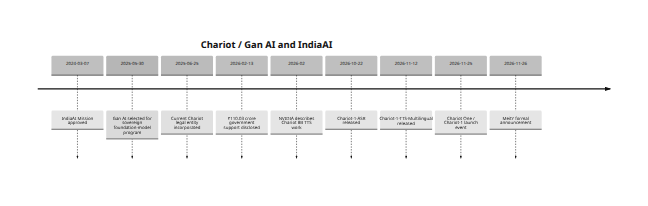
Timeline of key events
| Date | Event | Evidence/source type |
|---|---|---|
| Mar. 7, 2024 | Union Cabinet approves the IndiaAI Mission with a ₹10,371.92-crore outlay. | Government / official. [29] |
| May 30, 2025 | MeitY selects Gan AI, Soket AI and Gnani AI alongside Sarvam; Gan AI is tasked with a 70B multilingual “Superhuman TTS” foundation model. | Government / official. [30] |
| Jun. 25, 2025 | Current corporate entity is reported incorporated; registry mirrors link it to the former name Gan Artificial Intelligence Private Limited. | Corporate-registry aggregators; not underlying MCA filing. [31] |
| Feb. 13, 2026 | Government discloses ₹110.03 crore of support for Gan AI, including ₹88.02 crore compute support. | Government / parliamentary disclosure. [13] |
| Feb. 2026 | NVIDIA says Chariot is using NeMo to develop an 8B real-time TTS model. | Technology supplier / primary corporate source. [14] |
| Oct. 22, 2026 | Chariot releases Chariot-1-ASR Realtime. | Company / primary source. [32] |
| Nov. 12, 2026 | Chariot releases Chariot-1-TTS-Multilingual and publishes its own benchmark suite. | Company / primary source. [33] |
| Nov. 23, 2026 | Company announces Chariot One showcase. | Company / primary source. [34] |
| Nov. 25, 2026 | Chariot-1 foundation-model showcase takes place at Bharat Mandapam; MeitY Secretary S. Krishnan inaugurates the model. | Company + reputable media. [35] |
| Nov. 26, 2026 | MeitY/PIB publishes formal launch announcement specifying 11B MoE / 4B active parameters and three model sizes. | Government / official. [9] |
| Nov. 26, 2026 | Hugging Face indexes two Chariot IndicShift tokenizer repositories. | Independent platform index. [36] |
Implications for India’s sovereign-AI ecosystem
Policy and industrial capacity. Chariot is evidence that the IndiaAI Mission is moving beyond general policy statements into actual model-development subsidies, shared compute and launchable products. The Mission’s architecture explicitly combines compute, indigenous models, datasets, startup financing and skills, and the common-compute pool had exceeded 45,000 GPUs by mid-2026. Chariot therefore fits into a broader industrial policy rather than being an isolated startup announcement. [37]
At the same time, “sovereign AI” should be interpreted in layers. Chariot can plausibly claim domestic model design, Indian legal incorporation, India-based training and processing, Indian-language specialization and domestic control of product deployment. But India’s national compute pool uses commercially sourced accelerators, and NVIDIA describes Chariot as relying on its NeMo software framework. The strategic gain is therefore not hardware autarky; it is greater control over the model, data, deployment, talent and application layers despite continued reliance on globally supplied compute. [38]
Talent is a genuine strategic component. MeitY specifically highlighted Chariot’s founders as Stanford-trained researchers who returned to India, while the company says its team has experience in distributed training, multimodal research and large-scale model systems. This supports the government’s “reverse brain drain” thesis, although one startup is not evidence that India has closed the research-talent gap with the United States or China. [39]
Language technology may be the strongest strategic differentiator. India’s market contains large populations who interact primarily in Indic languages and frequently code-switch. Chariot’s focus on script sharing, code-mixed TTS and context-aware pronunciation addresses problems that English-first frontier-model developers have historically had less commercial incentive to optimize. If the reported IndicShift and speech gains survive independent testing, their strategic value could be greater than raw parameter count suggests. [40]
Data governance is both an advantage and a constraint. India’s Digital Personal Data Protection Rules, 2025 establish staged obligations governing notice, consent and processing of personal data, while the India AI Governance Guidelines promote trust, accountability, explainability, safety and innovation. Chariot says its TTS inputs and generated audio are processed in India. Those factors can make domestic hosting attractive for government, finance and other regulated applications, but the absence of a detailed Chariot-1 training-data disclosure leaves open important questions about provenance, consent, copyright, linguistic balance and contamination of evaluation data. [41]
Open ecosystems remain an unresolved policy test. MeitY has repeatedly said IndiaAI-supported models should contribute to an open-source ecosystem and be made available to government, startups and researchers, while AIKosh is designed as a national model-and-dataset exchange. Yet Chariot-1 LLM weights and licensing are not currently public. Whether the final model is released through AIKosh, under what license, and with what restrictions will be an important measure of whether public compute subsidies create broadly reusable infrastructure or primarily subsidize proprietary platforms. [42]
Export-control exposure remains a strategic vulnerability. India’s ability to train and serve leading models still depends heavily on accelerators and software originating from foreign suppliers. U.S. export-control policy continues to evolve around advanced-computing chips and even remote access to U.S.-origin high-end computing; a November 2026 BIS rule specifically tightened controls around remote access to advanced American computing infrastructure. India is not thereby cut off from NVIDIA hardware, but dependence on externally governed supply chains means “strategic autonomy” is incomplete until domestic accelerator, packaging, memory and systems capacity becomes much deeper. [43]
The most defensible conclusion is therefore narrower than the original wording: Chariot-1 is a credible milestone in India’s effort to acquire independent model-development capability, but not proof of complete AI technological independence. The government backing is concrete; the model’s 11B/4B-active specification is officially documented; the speech products are deployed; and the company has real research credentials. But independent LLM benchmarking, open weights, training-data transparency, reproducible compute disclosures and a clear license are still missing. Until those appear, the announcement should be treated as a significant sovereign-AI program milestone rather than as a fully independently validated frontier-model breakthrough. [44]
Source register
The most authoritative sources are the Press Information Bureau / MeitY launch announcement of November 26, 2026, the May 30, 2025 MeitY selection announcement, the February 13, 2026 government disclosure of IndiaAI support, and the March 7, 2024 Cabinet approval of IndiaAI; all are official Government of India sources. [45]
For primary company evidence, the most useful sources are Chariot’s Chariot One event page, its November 12 TTS announcement, its October 22 ASR announcement, its contact/legal pages, and its product/API pricing page. These establish the launch date, commercial products, registered-company wording and current service availability. [46]
For corporate identity, the useful secondary registry sources are Tofler and InstaFinancials, which both report CIN U62099UP2025PTC226753 and link the company to its previous Gan AI name; because these are registry aggregators rather than the MCA filing itself, they should be treated as strong secondary evidence, not the ultimate corporate record. [31]
For independent or external corroboration, ThePrint independently identifies Chariot as formerly Gan AI; Moneycontrol carefully distinguishes Chariot’s self-reported speech results from independently verified testing; NVIDIA’s own technical blog establishes Chariot’s use of NeMo and the earlier 8B TTS development track; and the Hugging Face index provides evidence of newly published IndicShift tokenizer artifacts. [47]
References
- [1] [8] [35] [46] Chariot One | Launch & Research Showcase | 25 November 2026
- [2] [31] Chariot Artificial Intelligence Financials | Company Details
- [3] [13] [21] [44] Press Release Page | Press Information Bureau
- [4] [15] Chariot-1 launched under IndiaAI Mission: first model from the lab formerly called Gan AI, but its efficiency and benchmark claims are self-reported and no paper or weights are public | Civique
- [5] [14] India Fuels Its AI Mission With NVIDIA | NVIDIA Blog
- [6] Contact | Chariot
- [7] [18] [20] [30] Press Release Page | Press Information Bureau
- [9] [23] [26] [38] [39] [45] Press Release Page | Press Information Bureau
- [10] [25] [33] Introducing Chariot-1-TTS-Multilingual | Chariot
- [11] [40] Press Release Page | Press Information Bureau
- [12] [36] Models – Hugging Face
- [16] [17] AI Text to Speech That Understands What It Reads | Chariot
- [19] [29] [37] Press Release:Press Information Bureau
- [22] Press Release Page | Press Information Bureau
- [24] Press Release: Press Information Bureau
- [27] [32] Introducing Chariot-1-ASR Realtime | Chariot
- [28] [42] Press Release Page | Press Information Bureau
- [34] News | Chariot
- [41] 24 THE GAZETTE OF INDIA : EXTRAORDINARY [PART I
- [43] Bureau of Industry and Security
- [47] India can become a global AI hub. But there is one obstacle, says Nvidia's Vishal Dhupar