BAYVO: Baycurrent and Treasure AI’s Enterprise Platform for Turning Face-to-Face Conversations into Actionable Data
Executive summary
On October 15, 2026, Baycurrent and Treasure Data, Inc.—operating under the Treasure AI brand since April 2026—launched BAYVO., a “Conversation-Driven Transformation” or CDX service intended to convert otherwise transient face-to-face business conversations into durable enterprise data. BAYVO is not simply a meeting-transcription application. Its commercial proposition combines Baycurrent’s transformation consulting, workflow redesign and change-management capabilities with Treasure AI Voice, an enterprise voice-intelligence stack built around PLAUD recording hardware, speech processing, Treasure AI’s cloud platform, and integration with customer-data and analytics systems. [1]
The strongest differentiation is architectural and organizational. Audio captured in meetings, store interactions, field visits or calls can be transferred from PLAUD hardware through a managed mobile application into Treasure AI’s cloud environment, transcribed with language detection and speaker diarization, summarized by large language models, and converted into structured outputs such as key topics and action items. Those outputs can then be associated with existing customer records, combined with other behavioral data in a CDP or DWH, queried by AI agents, or pushed into operational systems such as Salesforce. Baycurrent’s role is to redesign the corresponding frontline processes and drive adoption rather than leave customers with a standalone recording tool. [2]
Technically, several important details remain undisclosed. Treasure AI documents speaker diarization, language detection, LLM summarization, key-topic tagging, action-item extraction and some phrase/intent detection, but it does not publicly specify the exact ASR or LLM model versions used inside BAYVO, formal named-entity-recognition models, a dedicated sentiment model, model accuracy benchmarks, latency SLAs, or the algorithms used to match conversations to customer identities. The product literature says the ASR is PLAUD's proprietary system optimized for real-world conversation and supports 112 languages; it also describes detection of customer “intent” and “temperature,” competitor names and prohibited phrases, but that is not sufficient evidence to characterize the system as having a conventional sentiment-analysis or general-purpose NER pipeline. [3]
BAYVO currently appears to be a managed-cloud offering with edge preprocessing, rather than a conventional on-premises product. Treasure AI Voice performs microphone beamforming and some noise reduction on the recording device, while recordings ultimately enter Treasure AI’s cloud pipeline. Treasure AI states that Voice data is processed and stored in Japanese data centers, communications and stored data are encrypted, customer conversations are contractually and technically excluded from model training, and Voice data is retained for seven years under the advertised standard configuration. The broader Treasure AI platform is AWS-based and supports region selection, AES-256 encryption at rest, TLS 1.2+ in transit, SAML SSO, policy-based permissions and extensive auditability. No public evidence was found of a fully on-premises BAYVO or Treasure AI Voice deployment. [4]
Commercial pricing is not public. Treasure AI Voice states that pricing is individually quoted according to deployment scale and the customer's CDP environment; Baycurrent has not published a BAYVO rate card. The likely monetization structure is therefore enterprise-contract based: Voice licenses and associated recording hardware, Treasure AI/CDP or AI-platform capacity where required, integration work, and Baycurrent transformation/implementation services. That bundling could raise average contract value substantially relative to commodity meeting-transcription software but also increases sales-cycle length and implementation complexity. [5]
The closest Japanese competitor is RevComm's MiiTel RecPod, which already targets offline face-to-face conversations, supports transcription, meeting-note generation, conversation analytics and CRM/SFA integrations such as Salesforce and kintone. Internationally, Gong, Otter.ai, Notta, Zoom Revenue Accelerator and PLAUD's own team product overlap with portions of BAYVO's proposition. BAYVO's defensible position is less “best transcription engine” than capture + enterprise customer-data integration + governance + consulting-led process transformation. Its weakness is the reverse side of that strength: compared with lighter SaaS alternatives it is likely to be more expensive, slower to deploy, and dependent on successful organizational change. [6]
The Japanese market context is favorable. Japan continues to experience demographic pressure and loss of experienced labor: as of June 2026, only 59.8% of the population was aged 15–64 while 29.5% was 65 or older. Enterprise use of generative AI has also accelerated sharply, while Japanese organizations continue to cite AI skills shortages and governance readiness as obstacles. BAYVO directly addresses both issues by capturing tacit knowledge from experienced workers while outsourcing much of the technical and organizational implementation burden to Baycurrent and Treasure AI. [7]
The principal risks are not speech recognition alone. Privacy, employee surveillance, consent and notice practices, purpose limitation, retention, secondary use, inference errors and automated management decisions are strategically more important. Under Japan's APPI, recorded conversations can constitute personal information when individuals are identifiable, and organizations must notify or publish their intended purpose of use, although Japanese law does not generally impose an independent obligation to announce every recording merely because it is being made. Baycurrent's own launch material nevertheless explicitly says deployments must define recording scope, prior-notification/consent methods, retention, purpose and access rights. Globally, requirements can be materially stricter; in particular, the EU AI Act prohibits emotion-recognition systems in workplaces except for narrow medical or safety uses. [8]
Overall, BAYVO is best viewed as an enterprise data-creation and operating-model transformation layer whose raw material happens to be human conversation. If Baycurrent and Treasure AI can demonstrate measurable gains—reduced CRM administration, better conversion, fewer compliance incidents, faster employee training, preserved expert know-how and improved customer insight—the platform could occupy a valuable position between commodity AI notetakers and heavyweight customer-data/consulting programs. Its long-term success will depend on proving that the additional governance and integration burden produces materially more business value than cheaper transcription-first alternatives. [9]
Product, positioning and core capabilities
BAYVO is Baycurrent's proprietary CDX transformation service, with Treasure AI Voice providing its principal voice-data technology. Baycurrent describes three problems it is intended to solve: customer information is lost when employees reduce rich conversations to short CRM summaries; expert knowledge disappears as experienced workers retire; and transcription projects often stop at efficiency improvements rather than redesigning business processes. [10]
The service therefore operates at two levels. The first is a technology layer that records, transcribes, structures and analyzes conversations. The second is an operating-model layer in which Baycurrent redesigns processes, develops implementation plans, trains users, manages organizational change and stays involved through frontline adoption—primarily through an embedded consulting model. Treasure AI supplies voice capture, structuring, behavioral-data integration and AI analytics, while the companies jointly undertake CDP/DWH integration and systems implementation. [11]
Treasure AI Voice's documented capabilities are substantial. PLAUD Note Pro uses four MEMS microphones, a VPU and AI beamforming, with an advertised pickup distance of up to roughly five meters; NotePin S is a roughly 17-gram wearable using dual MEMS microphones. Device-side processing reduces environmental noise before transcription. Treasure AI advertises 112-language recognition, speaker-separated transcripts, automated summaries, action items, key topics and configurable summary templates. A desktop recorder, currently described as beta, extends capture to Zoom, Google Meet, Microsoft Teams, Webex and other computer-based conversations. [12]
For operational use, the system can identify or suggest follow-up tasks, the responsible person when discernible and deadlines mentioned in a conversation. Suggested tags are automatically generated from transcripts. The product page also describes detection of prohibited financial-sales phrases, competitor mentions and customer intent or “temperature,” and it positions those detections as triggers for compliance alerts or recommended next actions. [13]
The product should not, however, be credited with technical functions that have not been disclosed. General named-entity extraction is not documented as a discrete component. Formal sentiment-analysis methodology is not disclosed. Emotion recognition is not disclosed. Topic/tag generation and competitor-name detection suggest entity-like extraction, while “intent” and “temperature” analysis overlap conceptually with sentiment analysis, but the underlying classifiers, taxonomies and evaluation metrics are unknown. Likewise, no product-specific BAYVO patent portfolio is identified in the launch materials, and the vendors do not claim that BAYVO depends on proprietary patented speech-processing methods. [5]
The most important product distinction is the destination of the data. Treasure AI explicitly contrasts Voice with ordinary transcription software by feeding conversations into a customer-data layer where they can be resolved against customer profiles and combined with web, email, application, advertising and other behavioral information. The resulting conversation history becomes persistent context for analytics and AI agents rather than an isolated meeting transcript. [14]
Technical architecture, data flow and security
The following architecture synthesizes the flow explicitly described in Treasure AI Voice documentation and the BAYVO announcement. Components labeled “optional/inferred” describe plausible enterprise configurations rather than disclosed mandatory architecture. [15]
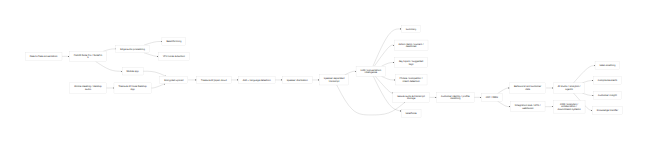
The capture pipeline is unusually well documented. A recording is transferred from a PLAUD device to the Treasure AI Voice mobile app over Wi-Fi or Bluetooth Low Energy. The mobile app then encrypts and uploads the file to Treasure AI's secure cloud storage; Treasure AI states that audio is not stored on PLAUD servers. During processing, audio is transcribed with language detection and speaker diarization, after which LLM-based summarization and action-item extraction run. [16]
Speaker diarization is explicit rather than inferred: the application automatically separates different speakers, exposes speaker-labelled segments, and permits users to assign names. The AI Studio Voice connector can retrieve timestamped turns containing the speaker label, start and end offsets, text and detected language. [17]
Storage is cloud-based. Treasure AI documents an S3-backed secure cloud store for Voice and says its broader platform is a managed AWS SaaS offering. For the Japanese Voice product, the vendor states that all processing and storage occurs in Japanese data centers and that Voice data does not leave Japan. Its product page advertises seven-year long-term retention, although customers deploying BAYVO should contractually verify whether that default is appropriate for their particular regulatory and minimization requirements. [18]
Treasure AI's wider enterprise-security controls include AES-256 encryption at rest, TLS 1.2+ in transit, optional customer-managed keys, SAML 2.0 SSO, MFA, policy-based permissions, OAuth 2.0/PKCE, audit logging and regional KMS keys. Treasure AI reports annual SOC 2 Type 2 and ISO/IEC 27001 audits and certifications including ISO 27701, 27017 and 27018. Its platform infrastructure spans AWS regions including Tokyo. [19]
For AI processing, Treasure AI says customer content is contractually barred from model training and identifies OpenAI and Anthropic through Amazon Bedrock among its named LLM providers for broader AI services. Its security architecture can mask PII before LLM endpoints and enforces regional inference constraints. The public documentation does not establish that every one of those broader-platform controls is necessarily invoked identically for every Treasure AI Voice workflow, so customer due diligence should treat the Voice-specific contract, subprocessor list and data-flow diagram as authoritative. [19]
Deployment is therefore best characterized as edge-assisted cloud SaaS. Edge processing occurs in PLAUD hardware, but the transcription, storage, summarization and enterprise analytics pipeline is cloud-based. BAYVO can coexist with a customer's existing CDP or DWH, making the overall enterprise architecture hybrid in the data-integration sense, but there is no published evidence of a fully on-premises Treasure AI Voice processing stack. [20]
Integration is one of BAYVO's strongest architectural characteristics. Treasure AI Voice directly supports sending summaries and to-do lists to Salesforce as Tasks; Treasure AI's broader Integration Hub supports scheduled transfers and many external systems, REST APIs are governed by the same access permissions as console functions, and webhook streaming can connect the CDP to third-party platforms. AI Studio can read Voice recordings, summaries, action items and diarized transcripts under the requesting user's existing permissions. [21]
Consequently, CRM integration is already concrete, while collaboration, analytics and compliance-system connectivity is better understood as platform-capable rather than universally prepackaged BAYVO connectors. Salesforce has a Voice-specific integration. Other CRM, warehouse, BI, messaging or GRC systems may be reachable through Treasure AI's general connector, API, webhook and systems-integration capabilities, but BAYVO has not published a definitive certified connector matrix. [22]
Commercial model, customers and go-to-market strategy
Public pricing for BAYVO does not exist. Treasure AI Voice explicitly says pricing is individually quoted according to deployment scale and the customer's CDP environment. Treasure AI's wider platform is also enterprise-sales oriented rather than publicly seat-priced, and Baycurrent's contribution is a consulting engagement encompassing strategy, process design, implementation, change management and frontline adoption. [20]
The economically plausible model is therefore a layered enterprise contract: hardware and Voice access, cloud/data processing, optional Treasure AI CDP/AI-platform consumption, integration services and Baycurrent consulting. This is an inference from the announced responsibilities and commercial structure rather than a disclosed tariff. The model is closer to a transformation program than to buying a $20-per-user meeting assistant. [9]
Target customers are organizations with large volumes of economically important conversations that currently disappear after they occur. Official use cases include field and face-to-face sales, retail and hospitality interactions, training and sales enablement, customer-harassment protection, financial-sales compliance and expert-knowledge transfer. Baycurrent also positions the service as applicable across industries rather than to a single vertical. [5]
Regulated industries are particularly attractive because recordings can create both customer insight and control evidence. Treasure AI illustrates financial-services use cases in which prohibited phrases such as unauthorized guarantees or requests for cash are detected and escalated. Baycurrent separately emphasizes objective verification that important explanations were given and the protection of employees from abusive customers. [23]
The partnership design is commercially logical. Baycurrent supplies access to senior enterprise transformation budgets and solves the “last mile” problem of workflow redesign and adoption; Treasure AI supplies the data and AI platform. Both firms jointly integrate with existing CDPs, DWHs and other customer infrastructure, while firms without a CDP can receive support beginning at architecture design. [11]
This is effectively a consulting-led land-and-expand strategy. An organization can begin with a bounded use case—sales meeting capture, customer-harassment evidence, compliance monitoring or knowledge preservation—and then broaden the conversation corpus into a shared customer-data and AI context layer. Treasure AI's ability to expose Voice transcripts to AI Studio strengthens that expansion path because accumulated conversations can support cross-meeting querying, follow-up drafting and agentic workflows rather than remaining static records. [24]
A structural advantage is Baycurrent's willingness to stay embedded through implementation and adoption. A structural risk is that this makes success partly dependent on consulting execution. BAYVO can fail commercially even if the speech technology works perfectly if employees resist recording, managers do not change processes, customer identifiers cannot be matched cleanly, or business units do not act on the resulting insights. That implementation dependency is implicitly recognized in both companies' repeated argument that transcription or AI introduction alone does not create transformation. [11]
Competitive landscape
BAYVO competes in several overlapping markets rather than one: AI meeting assistants, conversation intelligence, voice analytics, sales enablement, customer-data platforms and consulting-led AI transformation. The comparison below uses publicly disclosed vendor capabilities and current public pricing where available. “Custom” means the vendor requires a sales quote; absence of a feature means it is not clearly disclosed in the cited product material, not necessarily technically impossible. [25]
| Product | Face-to-face capture | Speaker separation / ID | AI summaries & actions | CRM / enterprise integration | Conversation analytics | Public pricing | Principal strength | Principal weakness vs. BAYVO |
|---|---|---|---|---|---|---|---|---|
| BAYVO / Treasure AI Voice | Yes; dedicated PLAUD hardware and desktop app | Yes | Yes; action owner/deadline extraction | Salesforce directly; CDP/DWH, APIs, connectors and joint SI | Topics, intent/“temperature,” phrase/competitor detection; broader AI analytics | Custom | Conversation data becomes enterprise/CDP context plus Baycurrent transformation support | Higher implementation complexity; exact model accuracy and pricing undisclosed |
| MiiTel RecPod | Yes; smartphone-based, optional microphones | Yes / transcription analytics | Yes | Salesforce, kintone, Slack, calendars, webhook | Talk speed, talk ratio, overlap, coaching, tags | Initial fee advertised from ¥0; substantive subscription quote-based | Strong Japan-native offline conversation analytics and coaching | Less explicit CDP-centric enterprise “long-term memory” proposition |
| Gong | Primarily digital meetings/calls; mobile capture available | Yes as part of call intelligence | Yes | Deep CRM and revenue-stack integration | Very strong sales/deal/coaching intelligence | Custom | Mature revenue intelligence and sales analytics | Less focused on ubiquitous Japanese physical/frontline conversation capture |
| Notta Business | Mobile/app recording and uploads | Yes | Yes | Salesforce, HubSpot and other CRM support; Zapier and collaboration integrations | Meeting-centric rather than full enterprise CDP analytics | $16.67/user/month, annual billing; Enterprise custom | Low price, broad integrations and easy deployment | Lighter governance/transformation and customer-data architecture |
| Otter Business / Enterprise | App recording plus online meeting agent | Yes | Yes, including decisions, risks and next steps | Salesforce, HubSpot; other workplace integrations | Meeting knowledge and enterprise insights | Business $19.99/user/month; Enterprise custom | Mature transcription/search/meeting-agent UX | Less specialized hardware and offline enterprise-data capture |
| Zoom Revenue Accelerator | Primarily Zoom Meetings and Zoom Phone | Yes through meeting/call transcription | Yes | CRM integration | Strong sales signals, objections, buying intent and coaching | Tiered licenses; current page does not disclose a simple public seat price | Native to Zoom, strong revenue workflow | Best fit when conversations already occur in Zoom ecosystem |
| PLAUD Team | Yes; dedicated PLAUD hardware | Yes | Yes | Connectors and Salesforce integration advertised/previewed | AI workflow and template oriented | Promotional $20–$28/user/month, depending billing/offer; regular price higher | Excellent hardware capture, direct low-friction deployment | BAYVO adds Japanese data/CDP architecture and Baycurrent transformation layer |
MiiTel RecPod is the most strategically relevant direct competitor in Japan. It is explicitly designed for offline face-to-face sales and counter-service interactions, transcribes conversations, generates minutes, evaluates metrics such as speaking speed and talk ratio, and connects to Salesforce and kintone. RevComm also supports Slack notifications, calendar integration and webhooks. [26]
MiiTel's advantage is maturity as a Japanese conversation-analytics specialist. RevComm reports that its overall MiiTel platform exceeded 110,000 users and 3,000 companies, and MiiTel RecPod has Japanese reference deployments including Mynavi. Its product story is particularly strong around coaching and quantified speech behavior. [27]
BAYVO's counter-position is that conversation should become a first-class enterprise customer-data source rather than remain primarily a coaching or meeting artifact. The Treasure AI stack resolves Voice information into a broader CDP and lets AI agents work across those records. Baycurrent then adds transformation consulting that most point products do not provide. [5]
At the inexpensive end of the market, Notta and Otter establish a strong price anchor. Notta Business is publicly listed at $16.67 per month per seat on annual billing and includes speaker identification, AI notes and CRM integrations. Otter Business lists $19.99 per user per month, while Enterprise adds richer CRM and structured-insight capabilities. These products make it difficult for BAYVO to justify itself merely through transcription or meeting summaries; its ROI case has to come from enterprise data integration, governance, compliance and process redesign. [28]
Gong and Zoom Revenue Accelerator create a different competitive pressure. Both already connect recorded conversations to pipeline and deal intelligence, with Gong offering CRM-linked call analytics, talk-pattern analysis and action items, and Zoom combining conversation data, CRM information and deal signals. For sales-centric customers, BAYVO must demonstrate that capturing physical conversations and combining them with broader customer data produces incremental insight that these revenue-intelligence suites cannot. [29]
Finally, PLAUD itself is a potential coopetition issue. The underlying hardware vendor now markets its own team plans with 112-language transcription, automatic speaker labeling, centralized device management, workspace-level data residency and emerging Salesforce connectivity. Treasure AI therefore needs the CDP, Japanese-sovereignty and enterprise-governance layer—and Baycurrent needs the transformation layer—to remain visibly more valuable than buying PLAUD directly. [30]
Market opportunity, economics and adoption risks
The macroeconomic rationale in Japan is credible. Japan's estimated population on November 1, 2026 was 122.43 million, down 530,000 from a year earlier; in June, the working-age population represented 59.8% of the total while people aged 65 and above represented 29.5%. The preservation and scaling of experienced employees' tacit knowledge is therefore more than a marketing narrative—it aligns with a structural demographic challenge. [31]
AI readiness is simultaneously increasing. Japan's 2026 Information and Communications White Paper reported a sharp rise in business generative-AI use, while OECD analysis still identifies shortages of AI-related talent as a comparatively significant obstacle for Japanese organizations. This creates favorable conditions for a managed solution in which an external consultant and established data platform absorb part of the implementation complexity. [32]
The addressable opportunity should nevertheless be understood more broadly than a “voice analytics market” forecast. BAYVO can draw spending from sales enablement, CRM automation, workforce training, compliance monitoring, customer-experience analytics, knowledge management and CDP modernization. An external market estimate places Japan's voice-analysis market at $162.9 million in 2025 and forecasts $517 million by 2034, but such syndicated-research estimates are definition-sensitive and should be treated as directional rather than as BAYVO's true TAM. [33]
The immediate economic case is strongest where a conversation has both high frequency and high downstream value. Sales organizations can eliminate manual CRM updates and identify winning patterns. Retail and hospitality operators can compare service quality across locations. Financial institutions can search for prohibited statements or verify required disclosures. Field-service organizations can preserve expert diagnostic reasoning. Employers can create evidence around customer harassment. [5]
Accuracy risk remains material. Real-world face-to-face audio includes overlapping speech, distance, reverberation, background music, industry jargon, code-switching and incomplete sentences. Treasure AI explicitly designed its capture chain around beamforming, VPU noise reduction and real-environment ASR because these conditions degrade ordinary online-meeting transcription. However, the vendor publishes no BAYVO-specific word-error-rate, diarization-error-rate, action-item precision/recall or compliance-detection false-positive/false-negative metrics. [14]
That omission matters because different use cases have different error tolerances. A slightly wrong sales summary may be inconvenient; a wrongly attributed compliance statement can trigger an investigation; a missed prohibited phrase can create legal exposure; and an incorrect “best practice” extracted from a high-performing salesperson can institutionalize poor behavior. Human review should therefore remain proportional to the consequence of the output.
Adoption is another major constraint. Customers and employees may speak differently once recording becomes ubiquitous, creating a measurement effect that reduces the naturalness of the very data BAYVO seeks to capture. Employees may perceive the system as surveillance if managers use talk ratios, sentiment-like signals or compliance detections for performance management. The technology's business value therefore depends heavily on governance, legitimate purpose, employee communication and restraint in secondary use—a finding consistent with Japan's AI Guidelines for Business, which emphasize human-centricity, privacy, safety, fairness, security, transparency and accountability. [34]
A further obstacle is data linkage. BAYVO's most differentiated value emerges when a conversation can be associated with the correct customer or account and merged with existing CRM/CDP data. That creates more value than standalone transcription, but identity resolution errors can also contaminate customer profiles. The vendors disclose that voice data can be matched to customer data using existing enterprise platforms, but they do not disclose BAYVO's matching logic or accuracy. [11]
Finally, seven-year default storage creates both value and risk. It produces a long longitudinal history for analysis and evidence, but it also raises breach impact, access-control complexity and data-minimization questions. Enterprises should not automatically equate technically available retention with legally or economically appropriate retention. [14]
Privacy, legal and ethical implications
In Japan, recordings fall under the Act on the Protection of Personal Information (APPI) when the content makes an individual identifiable. The Personal Information Protection Commission states that a business handling such data must notify the individual of, or publicly disclose, the purpose of use; however, APPI does not impose a blanket requirement to separately tell a customer merely that a telephone conversation is being recorded. [35]
That narrow legal point should not be interpreted as a recommendation for covert BAYVO deployment. Baycurrent's own release is more conservative: it states that recording scope, advance notification and consent method, retention period, purpose of use and access-right management should be clearly defined in the implementing company's agreement. Treasure AI similarly says it assists customers with operational rules for recording notice and consent in harassment-protection deployments. [9]
Voice data can become more sensitive if it is converted into a voiceprint used to authenticate or recognize a person. The PPC specifically notes that feature data extracted from recorded voice for the purpose of speaker authentication can constitute a personal identification code and therefore personal information in its own right. BAYVO publicly documents speaker diarization, but not biometric voiceprint authentication; organizations should ensure that later extensions into persistent speaker recognition do not silently change the legal character of the processing. [36]
Use of generative AI adds another APPI consideration. Japan's PPC warns organizations to ensure that personal data submitted to generative-AI services is used within the established purpose and, where personal data is entered without specific additional consent, to verify that the AI provider will not use it for model training or other purposes beyond supplying the requested output. Treasure AI's contractual prohibition on training with customer conversations is therefore an important compliance control rather than merely a marketing feature. [37]
Cross-border transfers are another potential issue. Under APPI, transferring personal data to certain foreign third parties can require prior consent and provision of information about the destination country's protections. Treasure AI Voice's commitment to Japanese processing and storage materially reduces this exposure for the core Voice workflow, but organizations still need to review every subprocessor, connector and downstream system—particularly when conversation-derived information leaves Voice and enters global CRM or analytics environments. [38]
Japan's non-binding but influential AI Guidelines for Business, updated to version 1.2 in 2026, place additional expectations around human-centric design, risk analysis, fairness, privacy, security, transparency and accountability. For BAYVO, those principles argue for documented model limitations, human review for consequential decisions, traceable source transcripts, correction mechanisms and safeguards against discriminatory inference. [34]
European deployments require substantially stricter analysis. Under the GDPR, systematic recording, profiling and dataset combination may require a Data Protection Impact Assessment when the processing is likely to create high risks for individuals. European guidance emphasizes lawful basis, transparency, necessity, proportionality and data minimization, while regulators consider continuous workplace audio monitoring particularly intrusive. [39]
An especially important boundary concerns emotion analysis. The EU AI Act prohibits emotion recognition in workplaces and educational institutions, except for narrowly defined medical or safety purposes. BAYVO's language about customer “temperature” should therefore be technically and legally distinguished from an emotion-recognition system before any European use. If the functionality merely classifies conversational intent or commercial interest from text, it may fall outside that prohibition; if it infers emotional states from voice or biometric signals, the legal analysis changes radically. The public BAYVO documentation does not disclose enough to resolve that distinction. [40]
Ethically, the largest risk is function creep. A system introduced to eliminate note-taking can evolve into employee scoring; a recording retained for customer service can become training data for performance management; an intent detector can become a hiring or promotion input. Technical access controls cannot by themselves prevent such drift. Contracts and internal governance should define permissible purposes, restricted inferences, prohibited employment uses, retention by use case, escalation thresholds, human-review requirements and mechanisms for customers and employees to challenge erroneous records.
The underlying asymmetry also deserves attention. The organization deploying BAYVO obtains a persistent, searchable representation of a conversation, while the customer or employee may have no comparable access to it. For sensitive industries, a defensible governance model would therefore provide conspicuous notice, a meaningful explanation of purpose, strict role-based access, audit logs, correction procedures, limited retention and human verification before consequential action. Those safeguards align with both Japan's AI-governance principles and Treasure AI's stated emphasis on auditability and permissions. [41]
Strategic assessment
BAYVO's core insight is sound: offline conversation is one of the last major enterprise data sources that remains systematically under-captured. Organizations already instrument websites, apps, advertising and email, yet much of the highest-context customer interaction still occurs verbally. Treasure AI explicitly positions Voice as filling that “blind spot,” and Baycurrent turns the resulting data stream into a process-transformation proposition. [14]
Its strongest moat is therefore likely to be composite rather than algorithmic. PLAUD supplies capable capture hardware; modern ASR and LLM summarization are increasingly commoditized; competitors already offer diarization, notes and CRM synchronization. The harder-to-replicate combination is enterprise-grade local data handling + existing CDP connectivity + accumulated customer context + transformation consulting + adoption support. [5]
That also defines the key commercial test. BAYVO has to demonstrate that integrating conversation into customer and enterprise data produces more value than simply buying MiiTel RecPod, Notta, Otter, Gong or PLAUD directly. Customers should therefore evaluate BAYVO against outcome metrics rather than transcription quality alone: CRM-entry time avoided, sales conversion uplift, onboarding time reduced, expert-knowledge reuse, compliance incidents detected, customer-harassment cases resolved, customer insights converted into product changes, and adoption rates among frontline workers.
The best early customers are likely to be large Japanese enterprises with substantial face-to-face interaction, mature CRM/CDP environments, stringent security requirements and enough scale for process redesign to pay back. Financial services, insurance, automotive retail, real estate, hospitality, high-value B2B sales and field-service operations fit that profile particularly well. This is an analytical inference from the product's documented use cases and integration strategy rather than a disclosed vertical sales plan. [5]
The strongest evidence of product-market fit would be reference deployments showing measurable business outcomes and independently validated accuracy in noisy Japanese environments. As of November 26, 2026, the launch materials provide product capabilities and strategic rationale but do not disclose BAYVO customer names, contract values, revenue contribution, pipeline, deployment count, model accuracy benchmarks or quantified ROI. Those are the most important unanswered diligence questions. [1]
BAYVO should therefore be regarded as a promising but still early-stage enterprise proposition. Its technical foundations are credible and unusually well aligned with Japanese enterprise concerns around data sovereignty, security and frontline adoption. Its competitive advantage will not be proven by transcription demos; it will be proven only if Baycurrent and Treasure AI can show that conversation-derived data changes decisions and workflows at scale while maintaining trust among the people being recorded. [42]
References
- [1] [9] [10] [11] BayCurrent Launches “BAYVO.”
- [2] [13] [15] [16] [17] [18] [21] [22] User Guide
- [3] [4] [5] [12] [14] [20] [23] Treasure AI Voice | PLAUDとCDPを統合する企業向けAIボイスレコーダー&AI議事録ソリューション
- [6] [26] 機能紹介 | MiiTel RecPod(ミーテルレックポッド) | 対面会話解析AI
- [7] [31] 統計局ホームページ/人口推計(2026年6月確定値、2026年11月概算値) (2026年11月20日公表)
- [8] [35] 顧客との電話の通話内容は個人情報に該当しますか。また、通話内容を録音している場合、録音している旨を相手方に伝えなければなりませんか。 |個人情報保護委員会
- [19] [42] CDP Security: How We Secure Customer Data | Treasure AI
- [24] September 2026 Release Note
- [25] MiiTel RecPod(ミーテルレックポッド) | 対面会話解析AI
- [27] Voice analysis AI “MiiTel” exceeds 110,000 total users and 3,000 companies. - RevComm Inc.
- [28] Notta Pricing: Compare Plans, Features & Costs
- [29] The Call Intelligence seat
- [30] Plaud AI Pricing: Free, Pro, Unlimited & Team Plans
- [32] # Progress of AI Use by Companies, etc.—Toward Better Utilization of AI—
- [33] Japan Voice Analysis Market 2026-2034 | IMARC Group | news | IPROS GMS
- [34] AI事業者ガイドライン(METI/経済産業省)
- [36] 「個人情報の保護に関する法律についてのガイドライン」 に関するQ&A |個人情報保護委員会
- [37] 生成AIサービスの利用に関する注意喚起等 -個人情報保護委員会-
- [38] 本人の同意に基づいて外国にある第三者に個人データを提供する場合、具体的にどのような点に留意する必要があるのか。 |個人情報保護委員会
- [39] Be compliant | Data protection guide for small business | European Data Protection Board
- [40] Navigating the AI Act | Shaping Europe’s digital future
- [41] (3) Reasonable and truthful support